
The fastest way to limit damage and tenant churn is a 24/7 response that prioritizes containment first and permanent repairs second. Set up a vetted vendor or staffed in-house on-call team, define your emergency threshold in writing, and run a live test call before you need it for real.
The one-sentence verdict: A 24/7 triage-plus-containment model, delivered by a reliable vendor or a staffed in-house team, is the most cost-effective way to protect property, retain tenants, and control emergency spend.
| Priority | Immediate next step |
|---|---|
| Recommended model | 24/7 triage + containment via vetted vendor or in-house on-call |
| Top priorities | Contain damage, protect life, secure site, escalate to decision maker |
| Tenant instructions | Update emergency contact info and access protocols this week |
| Authorization threshold | Define what on-call staff can approve vs. what needs owner sign-off |
| Live test | Run a test call within 30 days of setup |
Table of Contents
- What counts as an after-hours maintenance emergency?
- Which service model fits your portfolio?
- How does an effective after-hours response actually work?
- What does after-hours coverage actually cost?
- How do you choose the right after-hours vendor?
- How to set up after-hours coverage in 6 steps
- Why a full-service 24/7 vendor matters: Nationwide Maintenance
- Key Takeaways
- The case for doing less at 2 AM
- Nationwide Maintenance covers your after-hours gaps
- Authoritative sources and further reading
What counts as an after-hours maintenance emergency?
Emergency maintenance is required when lives, property, or operational viability face an immediate threat. That definition sounds simple until 11 PM on a Friday, when a tenant calls about a slow drain and your on-call tech is 45 minutes away. A documented decision rule prevents unnecessary dispatches and the premium labor bills that follow.
True emergencies share three characteristics:
- Active, ongoing damage that worsens by the hour (burst pipe, active roof leak, flooding)
- An immediate threat to life or safety (gas leak, no heat when outdoor temperatures are dangerous, elevator entrapment, structural failure)
- A security breach that leaves the property or tenants exposed (broken exterior door that won't latch, shattered ground-floor window)
Non-emergencies that can wait until business hours:
- One clogged sink when other plumbing in the unit works
- A burned-out light bulb in a non-emergency area
- A dripping faucet with no water damage risk
- HVAC comfort complaints when the temperature is not dangerous
The three-question decision rule: Is anyone at immediate risk? Is damage actively getting worse? Can service wait until morning without making either of those answers worse? If the answer to the first two is no and the third is yes, it is not an after-hours emergency.
Pro Tip: Post this three-question test inside your on-call script and on your tenant emergency line's hold message. It cuts unnecessary dispatches without leaving tenants feeling dismissed.
| Scenario | Classification | Recommended response |
|---|---|---|
| Burst pipe flooding a unit | Emergency | Dispatch now, shut off water main |
| Gas smell reported in building | Emergency | Dispatch + call utility company immediately |
| No heat, outdoor temp below 32°F | Emergency | Dispatch now |
| Elevator entrapment | Emergency | Dispatch + call elevator company |
| Clogged toilet (only one in unit) | Emergency | Dispatch now |
| Clogged toilet (second toilet works) | Non-emergency | Schedule next business day |
| Dripping faucet, no water damage | Non-emergency | Schedule next business day |
| HVAC not cooling, temperature is uncomfortable | Urgent | Stabilize, schedule AM repair |
| Broken exterior door lock | Emergency | Dispatch for security |
| Interior light fixture out | Non-emergency | Schedule next business day |
Which service model fits your portfolio?
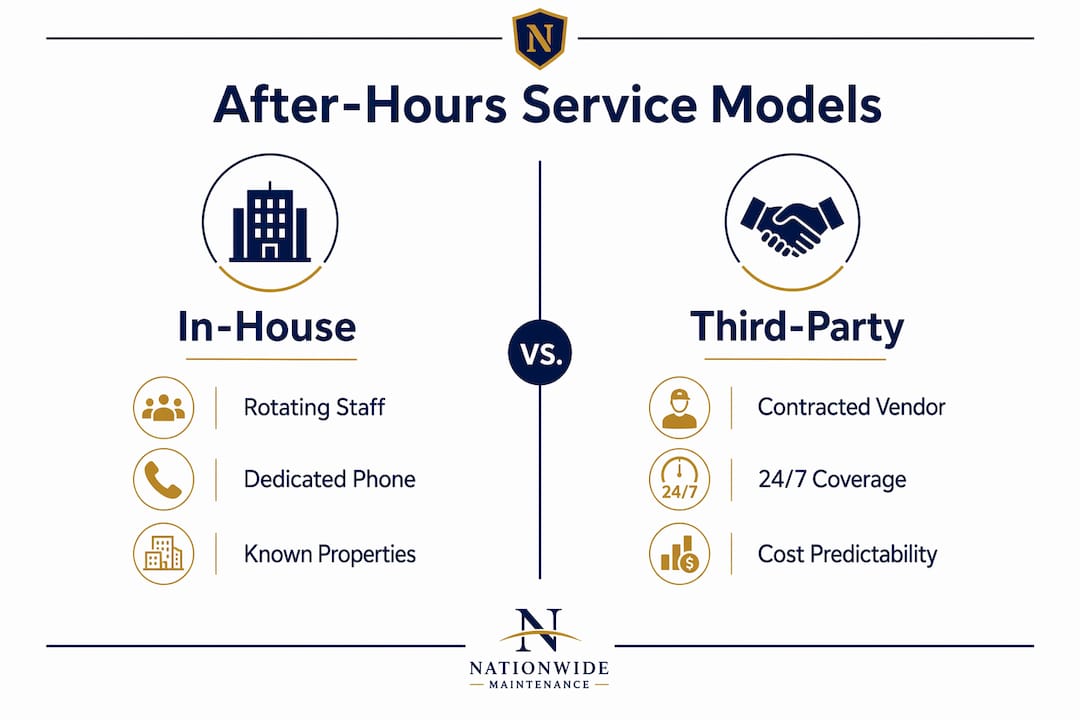
Three models dominate after-hours coverage. Each has a different cost shape and risk profile, and the right choice depends on your portfolio size, property type, and how much control you want over quality.
In-house on-call team
Your own staff rotate on-call shifts, carry a dedicated phone, and dispatch from home. They know the properties, the tenants, and where the water shutoffs are. The tradeoff: you absorb the full cost of on-call pay, overtime rates, and liability whether calls come in or not. This model works well for large portfolios (typically 500+ units) where call volume justifies the overhead, or for properties with highly specialized systems that outside vendors can't touch.
Third-party 24/7 vendor
A contracted facility maintenance company handles triage, dispatch, and on-site response. You pay either a retainer, a per-call fee, or a bundled rate. The vendor carries its own insurance, manages staffing, and handles documentation. Quality varies significantly by vendor, which is why SLA language and references matter so much. For most mid-size commercial portfolios, this is the most cost-predictable option.
Call-center triage only
A third-party answering service takes calls, filters true emergencies from non-emergencies, and either routes to your on-call staff or to a pre-approved trade contractor. This is the lowest-cost model but also the lowest-control one. Call-center agents often lack the technical knowledge to triage accurately, and a misclassified emergency can turn a $400 containment job into a $15,000 remediation.
| Model | Response control | Cost predictability | Quality assurance | Scalability |
|---|---|---|---|---|
| In-house on-call | High | Low (overtime varies) | High | Limited by headcount |
| Third-party 24/7 vendor | Medium-High | Medium-High (retainer) | Medium (SLA-dependent) | High |
| Call-center triage only | Low | High (flat fee) | Low | High |
How does an effective after-hours response actually work?
Containment and stabilization are the primary goals of any after-hours response. Full repairs belong in business hours, where you have access to the right parts, the right crew, and normal labor rates. Trying to complete a permanent fix at 2 AM usually costs more and often produces lower-quality work.
The four-phase protocol
- Phone triage (target: within 15 minutes of the call): A live person gathers the facts. What is the issue? Is anyone in danger? Is damage actively spreading? Based on answers, the call taker either dispatches immediately, advises the tenant on a temporary fix (shut off the water valve under the sink), or logs it for next-day scheduling.
- On-site containment with timely arrival depending on geography and trade: The responder's job is to stop the bleeding, not fix the root cause. Shut off the water main. Secure the door. Isolate the gas line. Contain the leak. The responder documents conditions with photos before touching anything.
- Escalation to decision maker: Any repair estimated above your pre-set authorization threshold gets a call to the property manager or owner before work proceeds. This single step prevents surprise invoices.
- Schedule permanent repair: The incident report goes into the work order system. The full repair is scheduled for the next business day or as soon as parts and crew are available.
Authorization threshold example
Pre-approve on-call staff to spend up to a moderate amount on containment without a call. Anything above that, or any repair that requires opening walls or replacing major components, requires owner or manager approval before the tech proceeds.
Responder checklist
- Confirm tenant contact and unit access before leaving for the site
- Document pre-existing conditions with photos on arrival
- Shut off the relevant utility or isolate the affected system
- Stabilize and secure; do not attempt full repair unless explicitly authorized
- Complete a written incident report before leaving the site
- Submit itemized time log with timestamps to the office by the next morning
Pro Tip: Require vendors to send a photo of the stabilized condition before they leave the site. It protects you in insurance claims and gives you a baseline for the follow-up repair crew.
Centralized dispatch and documented call tracking are what separate a professional after-hours operation from a patchwork of personal cell phone calls. Every call should generate a timestamped record, even if it results in a non-emergency classification.
What does after-hours coverage actually cost?
Pricing for off-hours facility maintenance comes in four shapes, and most vendors blend more than one.
| Pricing model | How it works | Best for |
|---|---|---|
| Hourly overtime rate | Billed per hour at a premium above standard rates | Low call volume, unpredictable needs |
| Flat on-call retainer | Fixed monthly fee for availability, separate from per-call labor | Portfolios that want cost predictability |
| Per-call fee | Fixed dispatch fee plus hourly labor | Mid-volume portfolios with defined scope |
| Bundled 24/7 contract | All-in annual or monthly contract covering availability and labor | Large portfolios, multi-location clients |
After-hours labor typically carries a meaningful premium over standard daytime rates. One vendor example lists on-call hourly rates starting at $110/hr, though rates vary by region, trade, and contract structure. Weekend and holiday rates often carry an additional surcharge on top of the standard after-hours premium.
Common inclusions vs. billable extras:
Retainer contracts usually include availability, phone triage, and a set number of dispatches per month. Billable extras typically include materials, specialty trade subcontractors, equipment rental, and any repair work beyond containment. Always ask for a written list of what is and is not included before signing.
SLA terms worth requiring:
- Phone triage promptly after the initial call
- On-site arrival for containment within a timely window (confirm the specific timing for your geography)
- Written incident report delivered within 24 hours
- Itemized invoice with timestamps for all after-hours premiums
Budgeting tip: A strong preventive maintenance program reduces emergency incidents over time. Tracking which after-hours calls repeat for the same systems or units lets you target preventive work where it cuts the most emergency spend. Building upkeep best practices, including preventive maintenance integration, are well documented for commercial portfolios.
Pro Tip: Add a cap on call-out fees in your contract. Without one, a vendor can charge a full dispatch fee for a call that turns out to be a non-emergency or a tenant error.
How do you choose the right after-hours vendor?
The interview is where you separate vendors with real 24/7 capability from those who list it on their website and route calls to a voicemail after 9 PM.

Questions to ask every candidate
| Question | What you're testing |
|---|---|
| Who physically answers the phone at 2 AM on a Sunday? | Live local dispatch vs. answering service |
| What is your typical on-site arrival window in our area? | Real local capacity |
| How do you document each call and what do we receive? | Transparency and invoice accuracy |
| What insurance do you carry, and can we be named as additional insured? | Liability protection |
| What trades do you self-perform vs. subcontract? | Quality control and response consistency |
| Can you provide references from similar property types? | Proven track record |
| What is your escalation path if the first responder can't resolve the issue? | Depth of bench |
Red flags to watch for
- No live person answers during your test call
- Vague or verbal-only pricing with no written rate schedule
- Unable to provide references from commercial or multi-unit properties
- No documented incident report process
- Unclear about who holds the liability when a subcontractor causes damage
Contract clause to insist on: "Vendor shall provide written incident documentation, including timestamped arrival and departure records and itemized labor and materials, within 24 hours of any after-hours service call. Repeated failure to meet the agreed response-time SLA shall constitute grounds for termination without penalty."
Live local response and rapid on-site arrival matter most for commercial and industrial emergencies, where delayed containment response can drastically increase repair costs. Ask specifically about arrival windows in your zip code, not a regional average.
Permission-to-enter protocols are an operational necessity that many managers overlook until a call-out gets canceled. Without clear tenant consent or pre-approved access policies, dispatchers may be legally unable to enter a unit, turning a containable emergency into a prolonged damage event and a wasted dispatch fee. Require pre-signed access waivers or lockbox codes as part of your tenant onboarding.
How to set up after-hours coverage in 6 steps
Getting a reliable after-hours process in place does not require months of planning. Most property managers can stand up a functional system in under two weeks.
- Define your emergency criteria in writing. Use the three-question decision rule from Section 2. Put it in a one-page document your staff, call takers, and tenants can reference.
- Choose your model. Match the model to your portfolio size and risk tolerance using the comparison table above. Most mid-size commercial portfolios benefit from a third-party 24/7 vendor.
- Negotiate SLA terms and pricing. Require the four SLA benchmarks: 15-minute phone triage, 1–4 hour on-site arrival, 24-hour incident report, itemized invoice. Cap call-out fees and define what is included vs. billable.
- Create tenant emergency instructions. Every tenant should receive a one-page document (or a digital equivalent) that tells them exactly what to do and who to call.
- Train your staff and call takers. Walk through the triage script, the authorization threshold, and the escalation path. Make sure everyone knows who has sign-off authority above the threshold.
- Run a live test call. Call your after-hours line from an unknown number. Time the response. Evaluate the triage quality. Fix gaps before a real emergency surfaces them.
Sample tenant emergency message
"For after-hours emergencies, call [Your Emergency Line] at any time. An emergency is any issue that poses an immediate safety risk or is causing active damage to your unit or the building. Examples include flooding, gas smells, no heat in freezing weather, or a broken exterior door. For non-emergencies, please submit a request through [Your Portal] and we will respond the next business day. If you call the emergency line for a non-emergency, you may be charged a service fee. Please have your unit number and a description of the issue ready when you call."
| Testing and performance metrics | Target |
|---|---|
| Quarterly live test calls | 1 per quarter, unannounced |
| Phone triage response time | Within 15 minutes |
| On-site containment arrival | Within 1–4 hours |
| Incident report delivery | Within 24 hours |
| Post-incident review | Within 5 business days |
| Repeat emergency rate (same system/unit) | Track monthly; investigate any repeat within 90 days |
Why a full-service 24/7 vendor matters: Nationwide Maintenance
The operational case for a full-service vendor goes beyond just having someone answer the phone. When your after-hours responder can also handle the follow-up cleaning, the temporary repair carpentry, and the pest control triggered by a water intrusion, you eliminate the coordination overhead that turns a single incident into a three-week vendor management project.
Nationwidemaintenance brings over 30 years of facility maintenance experience in the Tri-State area (New York, New Jersey, and Connecticut), serving commercial, retail, healthcare, and industrial clients under unified contracts. The 24/7 emergency facility response capability is built into the same contract that covers cleaning, pest control, construction, and landscaping, which means one call, one invoice, and one escalation path regardless of what the emergency uncovers.
The unified-vendor advantage: When a burst pipe at a retail location triggers water damage, mold risk, and a compromised floor, a single vendor that handles emergency containment, remediation, and follow-up construction resolves the incident faster and with less coordination friction than three separate contractors working from separate work orders.
For property managers overseeing multi-location commercial portfolios, that consolidation is not a convenience. It is a measurable reduction in response time and administrative overhead. Clients like Costco and CVS rely on this model precisely because a fragmented vendor roster creates gaps exactly when speed matters most.
| Nationwidemaintenance capability | Operational benefit |
|---|---|
| 24/7 emergency dispatch | Live response at any hour, not an answering service |
| Unified service contract | One invoice, one point of contact for all trades |
| Cleaning and remediation | Post-emergency cleanup handled without a second vendor |
| Construction and carpentry | Temporary and permanent repairs under the same contract |
| Pest control integration | Water damage follow-up pest issues addressed immediately |
| Preventive maintenance programs | Reduces repeat emergency incidents over time |
Key Takeaways
A 24/7 triage-plus-containment model, backed by a vetted full-service vendor and a documented emergency definition, is the most reliable way to protect property, control costs, and retain tenants.
| Point | Details |
|---|---|
| Containment first | After-hours response should stabilize and stop damage; full repairs belong in business hours. |
| Emergency definition | Document the three-question decision rule so staff and tenants classify issues consistently. |
| SLA benchmarks | Require 15-minute phone triage, 1–4 hour on-site arrival, and a 24-hour incident report in every contract. |
| Live test | Run an unannounced test call within 30 days of setup to confirm your vendor meets its SLA. |
| Nationwidemaintenance | A unified 24/7 contract covering emergency response, cleaning, construction, and pest control in the Tri-State area. |
The case for doing less at 2 AM
The counterintuitive truth about after-hours maintenance is that the best response is usually the most restrained one. Most property managers, when they first set up an on-call system, instinctively want their responders to fix everything on the first visit. That instinct is expensive.
A responder who shuts off the water main, photographs the damage, and secures the unit in 90 minutes has done the job correctly. A responder who spends four hours attempting a full pipe repair at midnight, without the right parts or a second set of hands, often creates a larger problem than the one they were called to fix. Containment is not a lesser response. It is the right response, and the research on emergency maintenance priorities consistently backs this up.
The other thing most guides understate: your vendor's documentation quality matters as much as their response speed. An incident report with timestamps, photos, and an itemized labor log is what makes an insurance claim defensible and what prevents a disputed invoice from becoming a relationship-ending argument. Before you sign any after-hours contract, ask to see a sample incident report. If it is a single paragraph with no timestamps, keep looking.
Nationwide Maintenance covers your after-hours gaps
Property managers who need a single vendor for 24/7 emergency response, ongoing cleaning, and post-incident repairs in the Tri-State area have a direct option in Nationwidemaintenance. The emergency services contract covers containment and dispatch around the clock, with the same crew available for follow-up construction, pest control, and cleaning under one agreement.
Getting started takes three steps: request a quote through the Nationwidemaintenance website, schedule an on-site onboarding visit to document your properties and access protocols, and run a live test call to confirm response times before you need them for real. For portfolios with maintenance contract requirements, Nationwidemaintenance offers structured retainer options that bundle preventive maintenance with 24/7 emergency coverage.
Contact Nationwidemaintenance to request a quote and confirm coverage for your locations.
Authoritative sources and further reading
| Source | What it covers | Why it's useful |
|---|---|---|
| UpKeep: Emergency Maintenance | Emergency vs. urgent distinction, containment priorities, preventive maintenance ROI | Best single reference for defining emergency criteria and SLA structure |
| JMRCo: 24/7 Emergency Maintenance | Tenant retention benefits of 24/7 coverage, tracking repeat emergencies | Useful for making the business case to ownership for after-hours investment |
| TUK Technical: 24/7 On-Call Services | Pricing examples, centralized dispatch documentation | Reference for pricing benchmarks and what to require in vendor documentation |
| DePue Mechanical: 24/7 Emergency Repair | Live local response, on-site arrival windows, diagnostic accuracy | Use when evaluating vendor response capability and SLA targets |
| Ardent Communities: After-Hours Emergency | Permission-to-enter protocols, tenant communication | Essential for setting up access waivers and tenant emergency instructions |
| Nationwidemaintenance: 24/7 Emergency Services | Full-service 24/7 emergency response for commercial portfolios in the Tri-State area | Direct resource for property managers evaluating a unified vendor option |