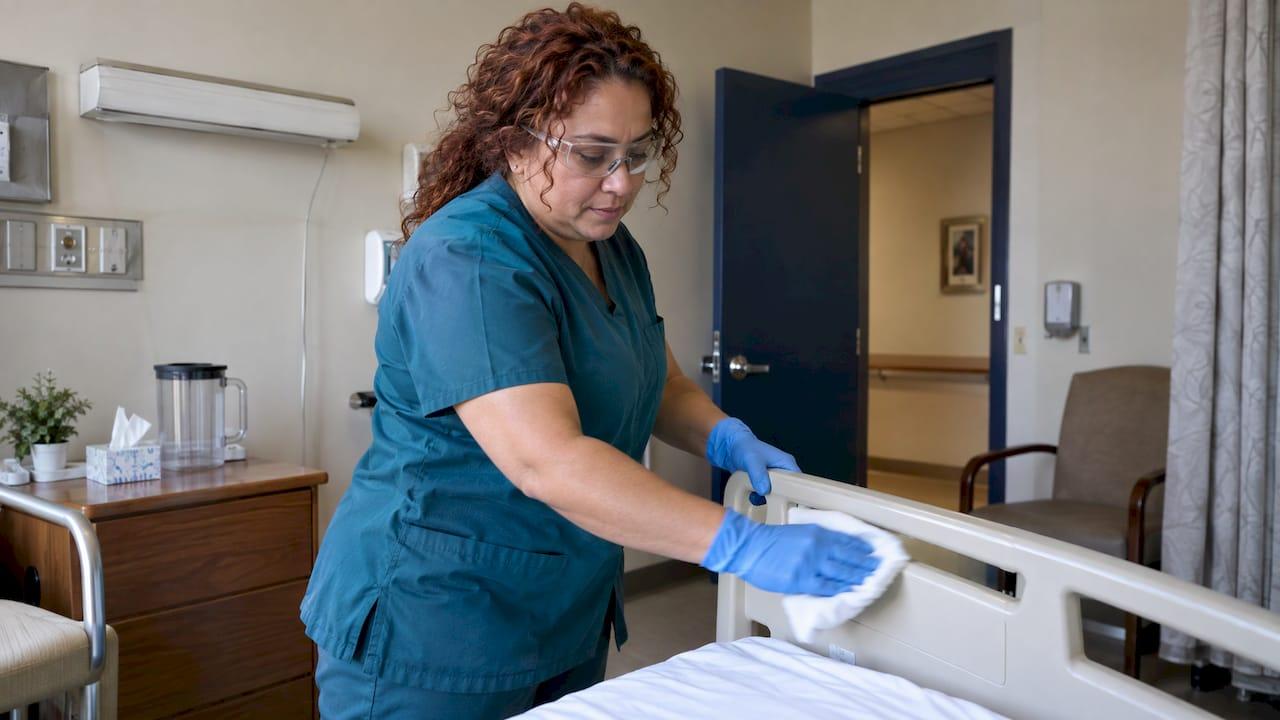
A C. diff cleaning protocol is a written routine that removes spores from patient rooms, restrooms and shared equipment using a spore-killing disinfectant, applied in two steps, with the right contact time and with documented checks. Ordinary all-purpose cleaners and alcohol-based products do not do this job. The routine only works when one team follows it the same way every day, and that is why facilities that run cleaning, restrooms, emergency response and other services under a single contract find it easier to keep the protocol consistent than those who split the work across several vendors.
This guide is for property managers, healthcare administrators and operations teams who contract for cleaning. It explains what the protocol contains, which products qualify, how to run each step, and what to write down so an inspector can see it was done.
TL;DR
- C. difficile (C. diff) forms spores that ordinary disinfectants and alcohol rubs do not reliably kill, so rooms need an EPA-registered sporicidal product, known as a List K agent.
- Clean first, then disinfect. CDC says a two-step process is needed for C. diff, not a combined one-step product.
- Follow the label for dilution and contact time, clean from cleaner to dirtier areas, and clean high-touch surfaces and shared equipment daily.
- Wash hands with soap and water after contact with feces or likely fecal contamination, and after glove removal in outbreak settings.
- Document every clean and audit it, so the protocol survives staff turnover and inspections.
Table of Contents
- What a C. diff cleaning protocol actually includes
- Choosing the right product
- The step-by-step routine
- Daily cleaning versus terminal cleaning
- Why the thoroughness matters: how long spores last
- Auditing the protocol
- Where one contract makes the protocol easier to hold
- Our perspective
- FAQ
- Sources
What a C. diff cleaning protocol actually includes
C. diff is a bacterium that causes severe diarrhea and colitis. It spreads through spores, a dormant, tough form that survives on dry surfaces. Spores reach people mostly on hands that touched a contaminated surface.
Per CDC's acute-care guidance, a protocol is made up of daily and terminal cleaning procedures and checklists for patient-care areas and equipment. It covers:
- daily cleaning of rooms of patients with suspected or confirmed C. diff infection using a sporicidal agent from EPA List K;
- cleaning and disinfecting the patient-care environment and high-touch surfaces at least once a day;
- cleaning and disinfecting all shared equipment before it is used on another patient;
- terminal cleaning after a patient is transferred or discharged, again with a sporicidal agent;
- sporicidal cleaning of other areas the patient visited, such as radiology, the emergency department or physical therapy.
CDC also says that confirmed patients should stay under contact precautions, in a single room with a dedicated toilet where possible, and that contact precautions continue for at least 48 hours after diarrhea resolves. Those are clinical decisions made by infection prevention staff. Your cleaning protocol is triggered by them, so the first line of the document should say who tells the cleaning team that a room is on C. diff precautions, and how.
The same logic applies outside hospitals. Nursing homes, schools, dental and medical offices, and shared restrooms in commercial buildings all see fecal contamination. Where a room has been used by someone with confirmed C. diff, the sporicidal routine applies. For general restrooms, a standing routine like our 9-step audit-ready restroom cleaning plan keeps the baseline high.
Choosing the right product
This is the decision that most often goes wrong, because many products look alike on the shelf.
Why the label matters
CDC explains that low-level disinfection is generally enough for routine environmental cleaning, but C. diff requires intermediate-level disinfection with sporicidal properties. Look for an EPA-registered product that appears on List K, the EPA's list of products with C. difficile spore claims, and read the label for the inactivation claim, the surfaces it is approved for and the instructions.
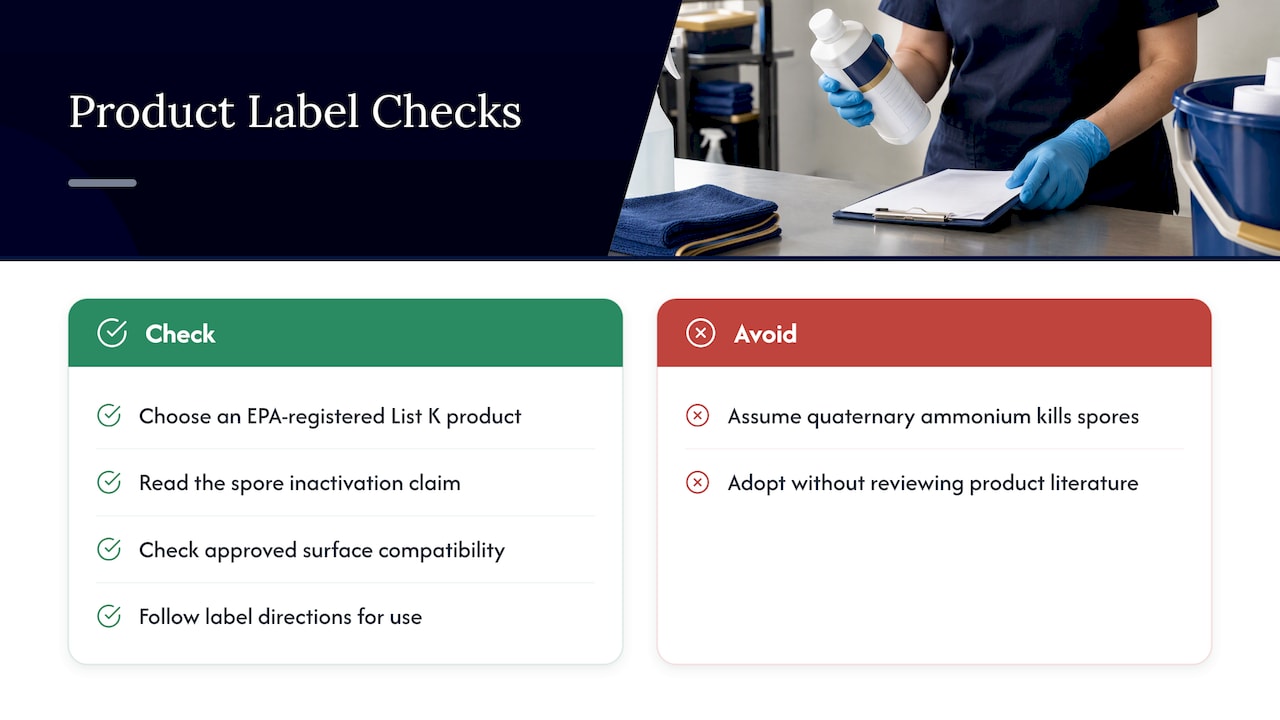
Queensland Health notes that quaternary ammonium compounds, the active ingredient in many common disinfectants, have poor activity against C. difficile spores and are not indicated. The UK Health Security Agency adds that some disinfectants are not sporicidal, so product literature should be reviewed before adopting an agent, and compatibility with your surfaces checked.
Bleach or a List K product
Two routes are widely used:
| Option | What it is | Key points |
|---|---|---|
| EPA List K product | Ready-to-use wipe or concentrate with a C. diff spore claim | Follow the label for dilution, contact time and surface compatibility |
| Diluted bleach | 1:10 dilution of 5.25% sodium hypochlorite in water, mixed fresh daily | Apply with a clean cloth saturated with the solution; check that surfaces tolerate it |
The 2022 SHEA/IDSA update says facilities should consider a 1:10 bleach dilution or another EPA-approved product with a C. diff sporicidal claim in outbreak and hyperendemic settings, with contact time that meets the manufacturer's recommendations for spores.
Concentration targets differ by country, which matters for any facility using international guidance. Canada's national guidance sets a floor of at least 1,000 ppm chlorine or another sporicidal agent for non-critical equipment. An Australian position statement reports that 5,000 mg/L free chlorine showed consistent efficacy against spores, while weaker dilutions varied. In the US, the practical rule is simpler: use a List K product exactly as labeled, or the 1:10 bleach solution your infection prevention team has approved.
Safe use of chlorine products
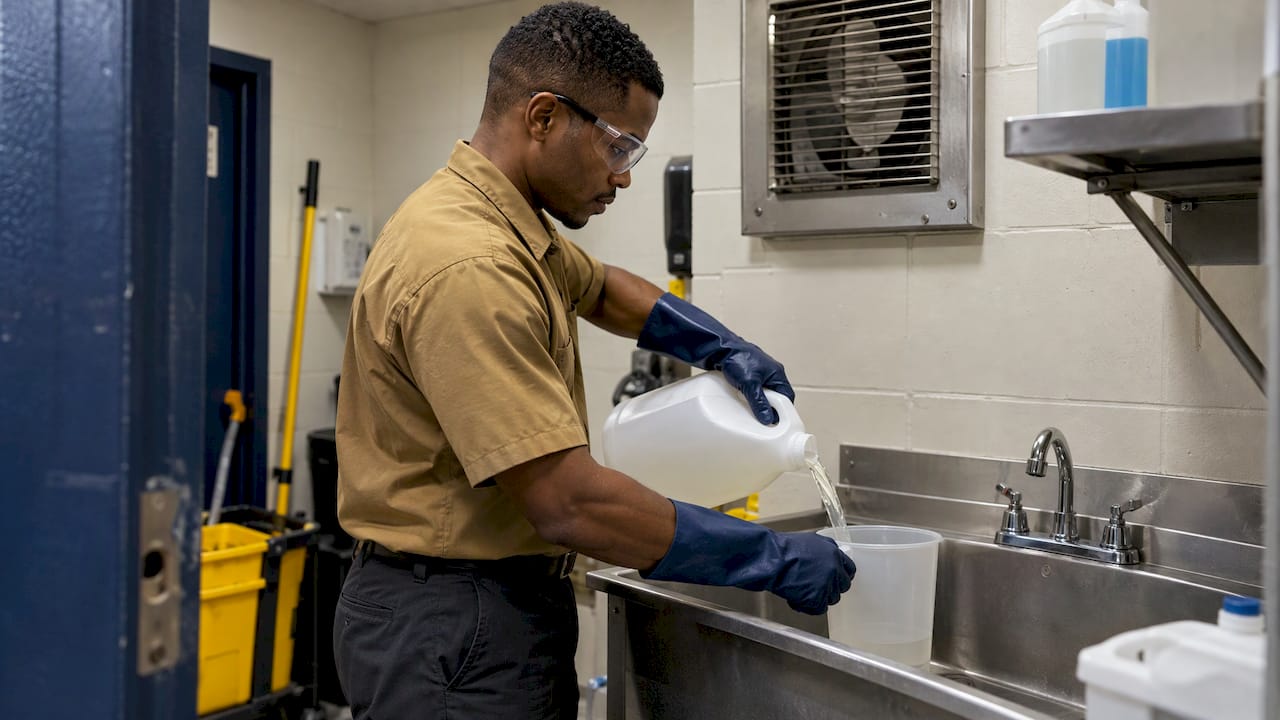
Strong chlorine solutions are a workplace hazard. The same Australian statement notes that very long contact times of 10 to 30 minutes can be an occupational health and safety hazard and are not practical in healthcare settings. In practice: mix in a ventilated space, label every bottle with the date, use the dilution the product or your protocol specifies, wear the gloves and eye protection on the label and the safety data sheet, and never mix bleach with other chemicals. Staff who handle these products should have chemical safety training on record.
The step-by-step routine
Use this as the skeleton of your written protocol. Each step lists what it takes and where it usually goes wrong.
-
Confirm the trigger. The room or restroom is flagged by clinical or infection prevention staff as a suspected or confirmed C. diff area. Where it goes wrong: the flag lives in a nurse's head and never reaches the night cleaning shift. Write down who communicates it and how, such as a door sign and a shift handoff note.
-
Put on PPE before entering. SHEA/IDSA strongly recommends gloves and gowns on entry to a C. diff patient's room and while caring for the patient. Where it goes wrong: gloves are reused between rooms or gowns are skipped for a quick wipe-down.
-
Stage supplies outside. Bring a fresh, dedicated set of cloths or wipes, the sporicidal product, a bucket for solution if you use bleach, and a bag for waste. Per CDC, never double-dip cloths into portable containers or shake mop heads. Where it goes wrong: a shared bucket carries spores from room to room.
-
Clean first. Remove visible soil with a detergent. CDC's clinician guidance stresses that routine cleaning must precede disinfection, because organic material shields spores from the disinfectant. The UK guidance also notes that detergent alone is not enough to decontaminate surfaces. Where it goes wrong: spraying disinfectant over visible soil and calling it done.
-
Work from cleaner to dirtier. CDC's environmental cleaning procedures say to wet a fresh cloth thoroughly in the solution, fold it to about hand size so it has eight usable sides, wipe systematically with mechanical action and rotate the cloth to use every side. Start with high-touch surfaces such as bed rails, call buttons, door handles and light switches, and finish with the bathroom and floor. Where it goes wrong: the toilet is cleaned first and the same cloth then touches the bed rail.
-
Disinfect and respect contact time. Apply the sporicidal product so the surface stays visibly wet for the full contact time on the label. CDC's guidance is to keep surfaces thoroughly wetted for the required time. Where it goes wrong: wiping dry in 30 seconds. Train staff to read the label's time, and mark it on the cart.
-
Treat the bathroom as the highest-risk zone. The UK guidance recommends that commodes, toilets and bathroom areas be disinfected with a sporicidal agent, with the frequency tied to whether the toilet is dedicated and whether it is visibly soiled. Where it is shared, disinfect after each use.
-
Handle equipment. IDSA/SHEA recommends disposable equipment where possible, and thorough cleaning and disinfection of reusable items, preferably with an equipment-compatible sporicidal disinfectant. Thermometers, blood pressure cuffs, wheelchairs and stethoscopes are the usual culprits.
-
Remove PPE and wash hands. Take off gloves and gown inside the room, then wash your hands. SHEA/IDSA says soap and water is preferred in outbreaks and after any contact with feces or likely contamination. CDC's clinician page adds that hand sanitizer does not kill C. diff. Where it goes wrong: a quick sanitizer rub at the door.
-
Log it. Record the room, time, product, cleaner, and who verified. This is the line an auditor asks for first.
Daily cleaning versus terminal cleaning
Daily cleaning happens while the patient or resident is still in the room. Terminal cleaning happens after discharge, transfer or when precautions end, and it is a full reset of the space.
The Canadian guidance asks for horizontal and frequently touched surfaces to be cleaned at least twice daily and when soiled. For terminal cleaning, it calls for cleaning the room and bathroom, changing privacy curtains and discarding the toilet bowl brush. The UK guidance asks for thorough terminal cleaning, curtain changes and consideration of vaporized hydrogen peroxide. An Australian position statement says that no-touch technologies such as hydrogen peroxide vapor and UV-C light may be used as an adjunct to terminal cleaning, not a replacement.
A practical terminal checklist:
- strip and bag linens and curtains per your laundry policy;
- discard disposable items and the toilet brush;
- clean, then disinfect every surface, high to low, cleaner to dirtier;
- disinfect all reusable equipment that stayed in the room;
- let surfaces air dry for the full contact time before the room is released;
- log the clean and have a second person verify it.
Why the thoroughness matters: how long spores last
Spores are patient. A 2024 review found that C. difficile spores on floors fell to 1 CFU only after five months, and that intensified surface cleaning and disinfection in a bundle has helped control cross-infection and outbreaks. APSIC's 2024 guideline similarly says spores can survive for four to five months or more on dry surfaces, and that a previous occupant with C. diff is a risk factor for the next one, presumably because terminal cleaning missed residual contamination.
Minnesota's long-term care toolkit adds that the organism can be shed in skin flakes for up to six weeks after diarrhea resolves, contaminating bed rails and tabletops. For a facility manager, the takeaway is that the missed surface, not the obvious one, is what causes trouble. Bed rails, remote controls, faucet handles and the back of the toilet flush lever need to be on the checklist by name.
Auditing the protocol
The SHEA/IDSA 2022 update recommends that facilities routinely assess the adherence and adequacy of cleaning: proper dilution, technique, coverage of high-touch surfaces, how often mop water and rags are changed, and clean-to-dirty sequencing. It also calls for frequent education of environmental services staff.
Build four checks into the routine:
- Dilution check. Test strips or a metered dispenser, logged daily, and bleach mixed fresh each day.
- Observation. A supervisor watches a clean start to finish against the checklist at set intervals.
- Touchpoint verification. A visual or instrument check of the surfaces most often missed. Our touchpoint disinfection checklist shows how facility managers pair this with ATP testing.
- Training records. Who was trained, on which product, and when.
For a wider view of what inspectors look for, our five-step guide to audit-ready healthcare cleaning standards covers documentation in more detail. A color-coded cloth and mop system, described in our guide to color-coded cleaning, also keeps restroom and patient-room tools from crossing over.
Where one contract makes the protocol easier to hold
A C. diff protocol fails at the seams: a handoff between shifts, a restroom handled by one vendor and floors by another, an emergency spill at 2 a.m. with nobody accountable. Every added vendor adds another set of products, training and logs to reconcile.
Nationwide Maintenance provides commercial cleaning, janitorial work, pest control, construction and landscaping under one contract for facilities in New York, New Jersey and Connecticut, with 24/7 emergency support. For a multi-site healthcare or retail operator, that means one set of expectations, one point of contact and one place where your written protocol is applied.
If your facility needs a cleaning team to run to your infection prevention plan, see our commercial cleaning services or our janitorial services.

Our perspective
Most C. diff failures we hear about are not product failures. They are coordination failures: the right disinfectant on the shelf, but nobody certain who owns the room after discharge.
That is why we think the facility manager's best protection is a single accountable contract. When cleaning, restroom care, pest control and emergency response sit with one vendor, there is one training standard, one set of logs and one phone number to call at any hour. We offer 24/7 emergency support so a contaminated room does not wait until morning.
We are also a WBE-certified vendor with more than 30 years of experience serving commercial, healthcare, government and retail clients across the Tri-State area. For organizations that need supplier diversity and a consolidated vendor list, one contract can deliver both without adding work for your team.
Write your protocol, have your infection prevention team approve it, and give it to one team that carries it out the same way in every building.
Nationwide Maintenance.
FAQ
Does hand sanitizer kill C. diff?
No. CDC states that hand sanitizer does not kill C. diff. After contact with feces or likely fecal contamination, SHEA/IDSA prefers washing with soap and water, and in outbreak settings it prefers soap and water generally because it removes spores more effectively.
What should I use to clean surfaces to prevent C. diff?
Use an EPA-registered disinfectant with a C. difficile sporicidal claim (List K) or a freshly mixed 1:10 dilution of household bleach, as Minnesota's health department describes. Clean visible soil first, then disinfect, and follow the label's dilution and contact time.
How long can C. diff survive on surfaces?
Spores can last for months. Published reviews report survival of four to five months or more on dry surfaces, which is why thorough terminal cleaning and daily high-touch cleaning matter.
How often should a C. diff patient's room be cleaned?
CDC calls for cleaning and disinfecting the patient-care environment and high-touch surfaces at least once a day, with a sporicidal agent, plus terminal cleaning after discharge or transfer. Canadian guidance asks for at least twice daily for frequently touched surfaces. Your infection prevention team sets the final schedule.
Sources
- CDC: Clinical Guidance for C. diff Infection Prevention in Acute Care
- CDC: C. diff Facts for Clinicians
- CDC: Cleaning Supplies and Equipment
- CDC: Environmental Cleaning Procedures
- Minnesota Department of Health: Cleaning Recommendations for Prevention of Infectious Agent Transmission
- Public Health Agency of Canada: C. difficile infection prevention and control guidance
- UK Health Security Agency: C. difficile infection, how to deal with the problem
- Queensland Health: C. difficile Infection Prevention and Control Guideline
- ASID/ACIPC position statement on C. difficile infection control
- IDSA/SHEA 2017 Clinical Practice Guideline for C. difficile
- IDSA: C. difficile practice guideline summary
- SHEA/IDSA 2022 strategies to prevent C. difficile infections
- Kramer et al. 2024: How long do pathogens retain replication capacity on inanimate surfaces
- APSIC Guidelines for Environmental Hygiene 2024