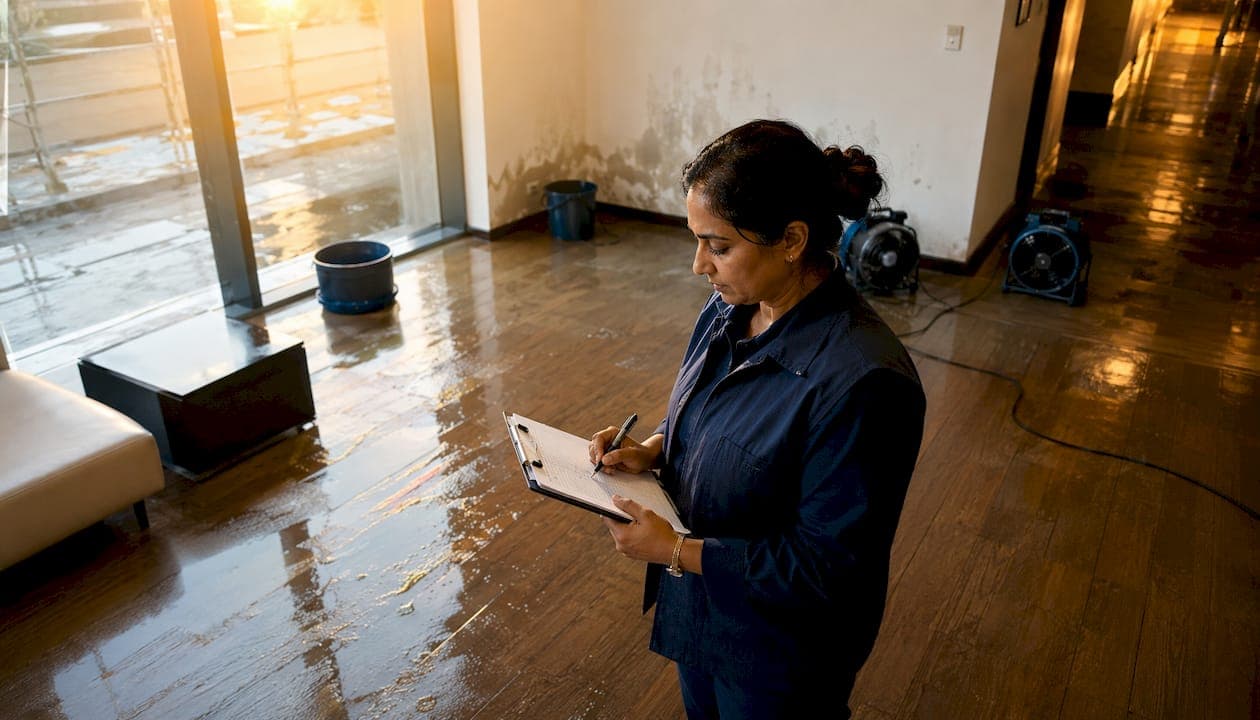
Emergency water damage cleanup is the coordinated process of assessing, extracting, drying, and restoring a commercial property after water intrusion, and the clock starts the moment water appears. Every hour without professional intervention increases the risk of mold colonization, structural decay, and equipment loss. The IICRC S500 Standard for Professional Water Damage Restoration defines mitigation as activities intended to minimize loss and prevent secondary damage, and it remains the benchmark insurers and contractors rely on. For facility managers, the stakes go beyond the building itself: operational downtime, liability exposure, and insurance claim outcomes all hinge on how fast and how correctly the response unfolds.
Key elements of an effective commercial response:
- Rapid response window: Secondary damage like mold and structural swelling can begin quickly after intrusion, making prompt professional action critical.
- IICRC S500 compliance: The industry reference standard for extraction, drying, and documentation protocols.
- Professional extraction and drying: Truck-mounted vacuums, LGR dehumidifiers, and air movers, not shop veins and box fans.
- Documentation from minute one: Moisture maps, daily logs, and photo records protect your insurance claim.
- Pre-established vendor contracts: The difference between a 2-hour response and a 6-hour search.
Table of Contents
- What facility managers must do immediately after water intrusion
- How professionals stabilize your facility and stop secondary damage
- Why documentation is your strongest asset in an insurance claim
- How SOPs and emergency contracts make your response faster and cheaper
- How to evaluate and select an emergency water damage cleanup provider
- What a realistic restoration timeline looks like
- What commercial water damage cleanup actually costs
- Questions to ask any water damage restoration contractor before signing
- Red flags that signal an unreliable emergency cleanup company
- Nationwidemaintenance brings 24/7 emergency response to commercial facilities
- Key Takeaways
What facility managers must do immediately after water intrusion
The first 30 minutes after discovery are the most consequential. Acting on instinct instead of a written plan is where most facilities lose ground, and where costs begin compounding.
- Shut off the water source at the nearest isolation valve or building main. If the source is unknown, shut off the main.
- Kill power to affected areas. Do not enter standing water with live electrical circuits nearby.
- Conduct a safety sweep for structural compromise, contaminated water (Category 3 black water requires immediate professional handling), and slip hazards.
- Document everything immediately with timestamped photos and video before any water is moved or materials are disturbed.
- Contain the spread by closing doors, deploying absorbent barriers, and blocking HVAC returns that could distribute contaminated air.
- Activate your emergency vendor contact using pre-established contracts, not a cold search.
Facility managers most commonly err by reacting ad-hoc instead of following written SOPs with pre-established vendor contacts. That gap between knowing what to do and having it written down is where response times balloon.
Pro Tip: Store your emergency vendor contact numbers in at least three places: your phone, your facility's emergency binder, and posted at the main electrical panel. When water is actively flowing, you won't have time to search.
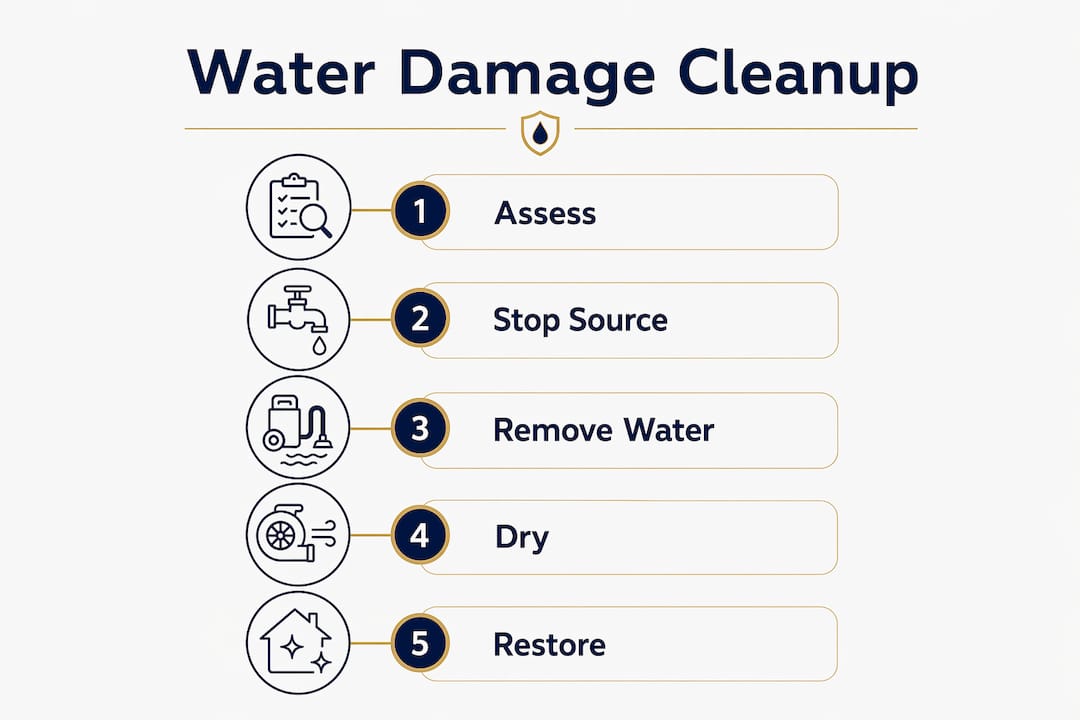
How professionals stabilize your facility and stop secondary damage
A professional restoration crew should arrive on-site promptly after notification to handle active water losses effectively. What they do in that window determines whether you're dealing with a 3-day cleanup or a 3-week reconstruction.
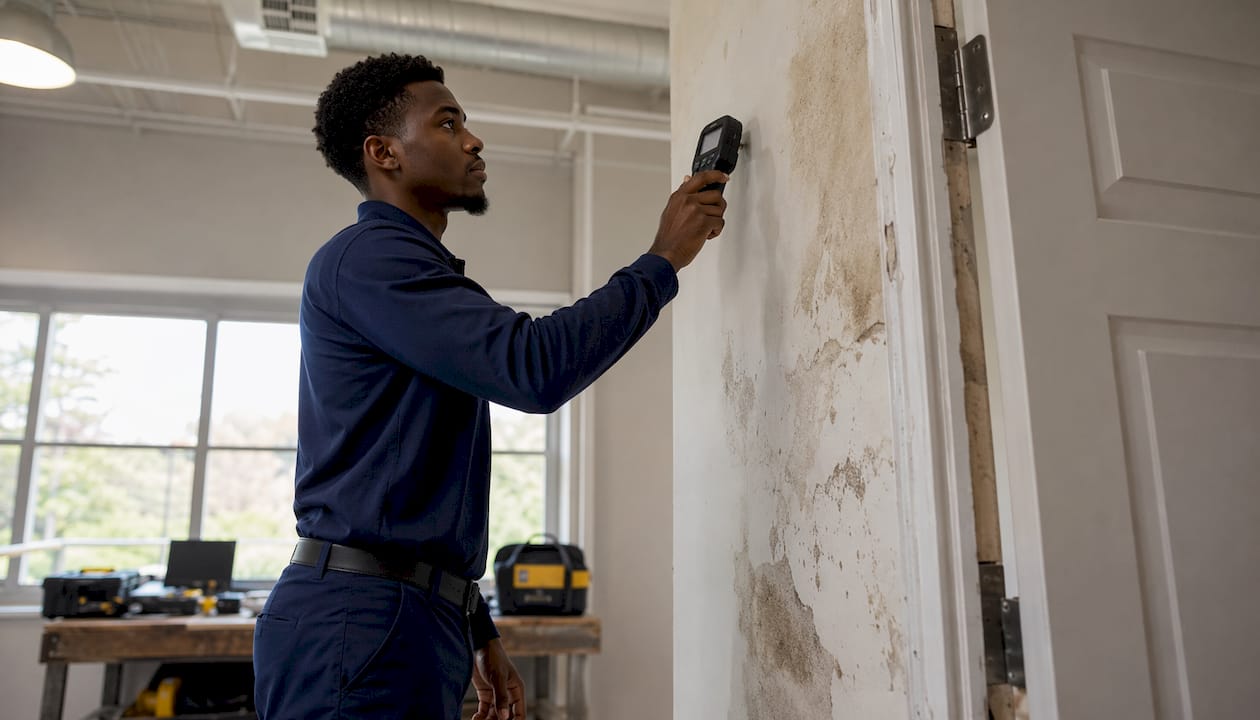
Moisture mapping comes first. Technicians use thermal imaging cameras and pin-type moisture meters to trace water migration behind walls, under flooring, and into ceiling assemblies. Psychrometric measurements, tracking temperature, relative humidity, and dew point, establish a baseline for drying calculations and guide equipment placement.
Water extraction follows immediately. Commercial settings can use truck-mounted extractors capable of removing water at high volumes, along with weighted extraction tools that pull moisture from carpet and subfloor simultaneously. Once standing water is gone, LGR dehumidifiers and air scrubbers take over to stabilize the environment.
Key technical controls deployed during professional restoration:
- LGR (Low Grain Refrigerant) dehumidifiers: Pull moisture from air at low humidity levels where standard units stall.
- High-velocity air movers: Accelerate evaporation from structural materials.
- HEPA air scrubbers: Required in Category 2 and 3 losses to capture airborne contaminants and prevent cross-contamination.
- Psychrometric monitoring: Readings logged every 24 hours until drying goals are met.
- HVAC inspection and isolation: Post-intrusion HVAC systems must be inspected and cleaned before being returned to service, particularly in healthcare or food-service facilities.
Pro Tip: Ask your restoration contractor for daily psychrometric logs. If they can't produce them, they aren't meeting IICRC S500 documentation requirements, and your insurer will notice.
Why documentation is your strongest asset in an insurance claim
Thorough documentation is what separates a paid claim from a disputed one. Timely, professional restoration requires detailed records of moisture levels, equipment deployment, and daily progress to meet IICRC S500 standards and support insurance claims. Missing records give adjusters grounds to reduce or deny payouts.
| Documentation Type | Purpose | Responsible Party |
|---|---|---|
| Timestamped photos and video | Establish pre-remediation damage scope | Facility manager (initial), contractor (ongoing) |
| Moisture maps | Track water migration and drying progress | Restoration contractor |
| Daily equipment logs | Verify drying system deployment and runtime | Restoration contractor |
| Psychrometric readings | Confirm drying goals are met per IICRC S500 | Restoration contractor |
| Incident report and scope narrative | Define loss boundaries for adjuster review | Facility manager and contractor |
Facility managers must document safety hazards, water source confirmation, scope boundaries, and moisture mapping during initial assessment. Share this file with your insurance adjuster proactively, before they ask. Carriers participating in preferred vendor programs frequently require IICRC-certified documentation as a condition of claim processing.
How SOPs and emergency contracts make your response faster and cheaper
Written SOPs transform water damage response from a reactive scramble into a controlled process. Facility management experts stress that prepared SOPs and staff training are what separate facilities that recover quickly from those that don't.
A water damage SOP should define:
- Who has authority to shut off utilities and activate emergency vendors
- Communication chain: who notifies building ownership, insurance, and tenants
- Initial containment steps staff can safely perform before contractors arrive
- Location of water main shutoffs, electrical panels, and emergency equipment
- Documentation responsibilities and where records are stored
Pre-established emergency service contracts allow restoration teams to be dispatched quickly, cutting response time and minimizing damage costs. Without a contract, you're negotiating terms while water spreads.
Pro Tip: Run a tabletop water damage drill annually. Walk your team through the SOP using a hypothetical scenario. You'll find gaps in the plan before a real event does.
How to evaluate and select an emergency water damage cleanup provider
Not every restoration company is equipped for commercial losses. The criteria that matter most:
- IICRC certification: Non-negotiable for insurance-driven work. Verify the firm, not just the technician.
- Response time guarantee: Industry standard is 2–4 hours. Get it in writing.
- Commercial loss experience: Large-format buildings, multi-tenant properties, and occupied facilities require different protocols than residential jobs.
- Licensing: Commercial losses above certain thresholds require a licensed contractor in many states. Confirm the firm meets your state's requirements.
- 24/7 availability: Water doesn't wait for business hours. Confirm actual 24/7 dispatch, not an answering service.
- Insurance coordination experience: A contractor who has worked directly with commercial adjusters will document to insurer expectations from day one.
What a realistic restoration timeline looks like
Timeline varies by loss category and affected area, but the general framework holds across most commercial events:
- Hours 1–4: Emergency dispatch, safety assessment, source control, initial extraction
- Hours 4–24: Continued extraction, moisture mapping, equipment deployment
- Days 2–5: Active structural drying, daily psychrometric monitoring, containment management
- Days 5–10: Drying goal verification, equipment removal, antimicrobial treatment if required
- Days 10+: Reconstruction and finish restoration begin after mitigation file is closed
A small single-room loss may resolve in 3–5 days. A multi-floor event in an occupied building can run several weeks. The Incident Command System (ICS) framework helps facility managers assign clear operational roles across that extended timeline.
What commercial water damage cleanup actually costs
Cost ranges vary widely based on loss category, affected square footage, and required reconstruction. General cost drivers include:
- Water category: Category 1 (clean water) costs less to remediate than Category 3 (sewage), which requires full containment, PPE, and antimicrobial treatment.
- Affected area: Larger floor plates, multi-story losses, and concealed structural damage increase scope and equipment needs.
- Drying duration: Equipment rental and labor costs accumulate daily until drying goals are met.
- Reconstruction scope: Mitigation and restoration are billed separately. Flooring, drywall, and finish work are not included in the mitigation invoice.
For commercial properties, losses that exceed $10,000 in states like California and Florida require a licensed contractor by law. Budget planning should account for both the mitigation phase and the reconstruction phase as separate line items.
Questions to ask any water damage restoration contractor before signing
- Are your technicians IICRC-certified, and can you provide documentation?
- What is your guaranteed on-site response time, and is it written into the contract?
- Do you have experience with losses in occupied commercial facilities?
- How do you handle insurance documentation and adjuster coordination?
- Who is the single point of contact for daily updates throughout the project?
- What does your drying protocol look like, and how do you determine when drying goals are met?
Red flags that signal an unreliable emergency cleanup company
- No written response time guarantee. Verbal promises mean nothing when water is spreading.
- Pressure to sign immediately without reviewing scope. Legitimate contractors document before they invoice.
- No IICRC certification. Some insurers will reject claims if non-certified firms performed the work.
- Cash-only payment demands or unusually low bids. Both signal a contractor cutting corners on equipment, labor, or licensing.
- No daily progress reporting. Without logs, you have no proof of work for your insurer.
- Recommending unnecessary demolition early. Aggressive tear-out before moisture mapping is complete inflates scope and costs.
Nationwidemaintenance brings 24/7 emergency response to commercial facilities
When water intrusion hits a commercial property, the difference between a contained loss and a prolonged shutdown often comes down to who you already have on contract.

Nationwidemaintenance has served commercial, retail, healthcare, and industrial facilities across New York, New Jersey, and Connecticut for over 30 years. The 24/7 emergency response capability meets industry-standard dispatch windows, with crews equipped for water extraction, structural drying, post-loss cleaning, and coordinated reconstruction under a single contract. That integrated model means one call covers water damage mitigation, post-event cleaning, and any follow-on construction work, without managing three separate vendors during a crisis. Documentation support for insurance claims is built into every engagement. Property managers working with Nationwidemaintenance for facility maintenance gain a pre-established emergency relationship that activates immediately when a loss occurs. Contact Nationwidemaintenance today to set up an emergency service agreement before the next incident.
Key Takeaways
The first critical hours after water intrusion determine whether a commercial loss stays manageable or escalates into a structural and financial crisis.
| Point | Details |
|---|---|
| 24-hour response window | Secondary damage like mold begins within 24 hours; professional extraction must start immediately. |
| IICRC S500 compliance | Insurers frequently require certified firms; non-certified work can result in claim denial. |
| Documentation from day one | Moisture maps, equipment logs, and photo records are required to support insurance claims and meet restoration standards. |
| SOPs and pre-established contracts | Written procedures and vendor contracts cut response time to 2–4 hours and reduce total loss costs. |
| Nationwidemaintenance | Provides 24/7 commercial emergency response across NY, NJ, and CT under a single integrated facility maintenance contract. |