For verified, audit-ready green commercial cleaning in the Tri-State area, Nationwidemaintenance is a recommended starting point. Before you sign anything with any provider, request three documents this week:
- A product certification list confirming Green Seal or EPA Safer Choice compliance for every chemical used on-site
- CIMS (Cleaning Industry Management Standard) certification or equivalent program evidence showing independently verified training and QA processes
- A sample IEQ/LEED O+M credit packet so you know what documentation you will receive for auditors
Then request a line-item quote and a 30-day pilot with defined KPIs before committing to a full contract.
Table of Contents
- What does a green commercial cleaning program actually cover?
- Why green cleaning produces real, measurable results
- Which certifications and standards should you require?
- How a credible green cleaning program runs day to day
- What drives the price of eco-friendly cleaning services?
- How to choose a green cleaning provider: a practical checklist
- How Nationwidemaintenance delivers audit-ready green cleaning
- Key Takeaways
- Why integrated facility providers make sustainability reporting simpler
- Get a green cleaning pilot started with Nationwidemaintenance
- Authoritative sources for verifying green cleaning standards
What does a green commercial cleaning program actually cover?
A credible program covers far more than swapping conventional products for greener ones. The full scope should include routine janitorial services (daily or nightly), interior floor care and finishing with low-VOC products, carpet extraction, window cleaning, and high-touch surface disinfection on a documented schedule.
Specialty services matter too. Post-construction cleaning, bio-cleaning after incidents, and periodic deep-clean cycles should all be available under the same contract. Multi-site clients need centralized account management, a single point of contact, and standardized SOPs that travel across locations.
When you review a proposal, every task should appear as a line item: square footage, service frequency, specific task descriptions, product codes, and reporting cadence. A quote that bundles everything into one monthly number is not a green program. It is a cleaning contract with green marketing on top.
Why green cleaning produces real, measurable results
The clearest wins show up in indoor air quality. HEPA-filtered vacuums capture particulates that standard vacuums recirculate, and low-VOC floor care products reduce the chemical off-gassing that accumulates in sealed commercial buildings. Occupants breathe cleaner air, and that has a direct connection to cognitive performance and absenteeism.
Key outcomes property managers consistently report:
- Lower VOC exposure from switching to non-toxic cleaning products and low-VOC floor finishes
- Reduced water and chemical consumption through microfiber systems and concentrated dispensing, with industry reports citing reductions of up to 95% in some workflows
- Procurement traceability via green purchasing logs that satisfy LEED O+M auditors and sustainability reporting requirements
- Consistent cleaning quality through documented SOPs and supervisor-led QA walk-throughs
- Possible cost neutrality when concentrated chemistries and reusable applicators offset the higher per-unit cost of certified products
Statistic to know: Microfiber cloths and concentrated dispensing systems can reduce water and chemical use significantly in certain workflows, making them a standard requirement for LEED-compliant cleaning logs.
The sustainability angle also supports tenant retention. Corporate tenants with their own ESG commitments increasingly ask landlords for documentation of building practices. A green cleaning program gives you something concrete to show them.
Which certifications and standards should you require?
Genuine green cleaning depends on independently verified standards, not vendor marketing claims. Require these specifically:
- Green Seal (GS-42): Third-party certification covering product safety, performance, and environmental impact. Ask for the certificate number and verify it on Green Seal's public database.
- EPA Safer Choice: A U.S. EPA program that evaluates every ingredient in a formulation for human and environmental safety. Products carrying this label have passed ingredient-level review.
- LEED O+M support: Providers should be able to supply IEQ credit documentation, green cleaning policy templates, and product certification logs formatted for auditors.
- ISSA/CIMS: The Cleaning Industry Management Standard provides independent verification of a provider's training, QA, and management processes. Procurement teams should prioritize CIMS-certified providers because the standard covers green building maintenance practices specifically.
Documents to demand with any proposal:
- Safety Data Sheets (SDS) for every product used on-site
- Green purchasing logs showing product name, certification, and purchase date
- IEQ/LEED O+M credit worksheets
- Staff training records tied to documented green procedures
To verify claims, cross-reference the CIMS certificate number against ISSA's public registry and pull two or three SDS sheets to confirm the products listed match what the provider actually uses.
Pro Tip: When evaluating eco-labels on cleaning products, use a third-party verification resource like this eco-label comparison guide to confirm what each seal actually covers before accepting a vendor's claim at face value.
How a credible green cleaning program runs day to day
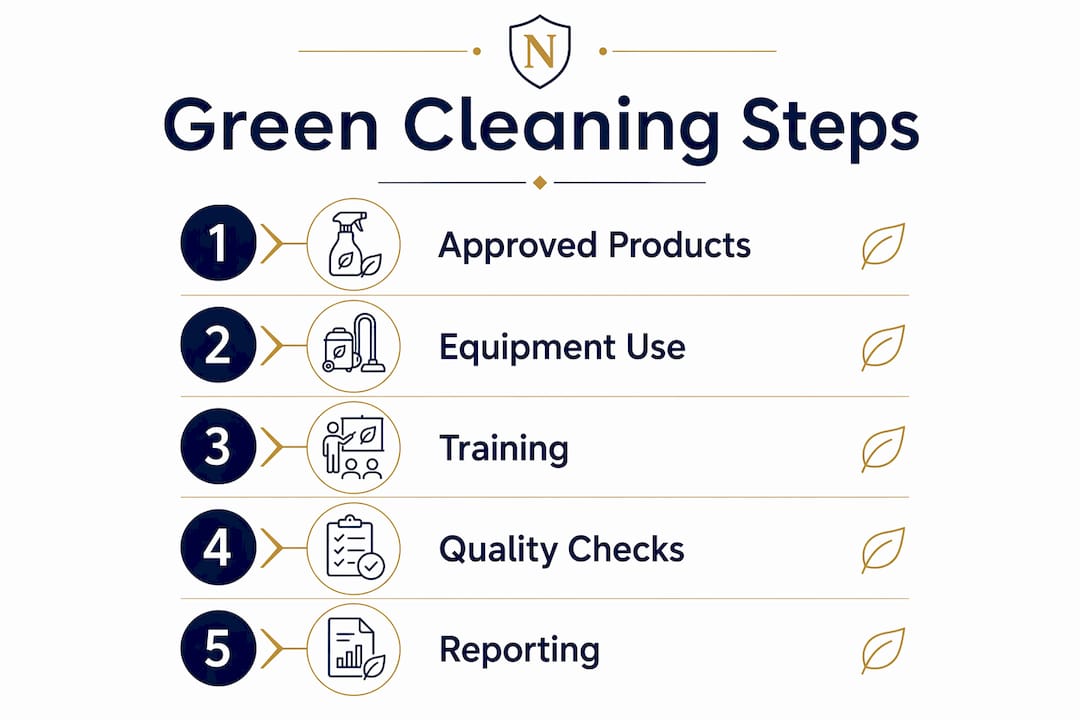
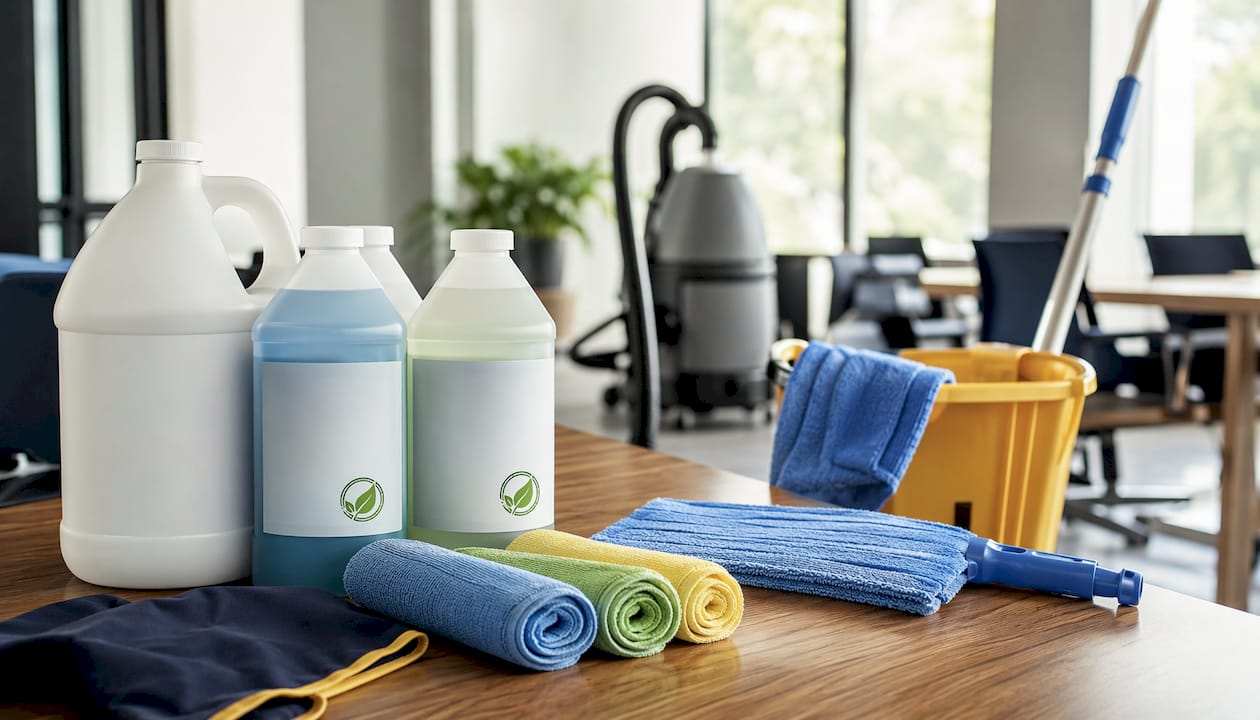
Product selection starts with an approved product list tied to Green Seal or EPA Safer Choice certifications. Concentrated dispensing systems control dilution ratios, reduce plastic waste, and make procurement auditable. SDS sheets should be accessible on-site, not just filed somewhere at the vendor's office.
On the equipment side, HEPA vacuums and microfiber systems are non-negotiable for any program claiming IAQ benefits. Low-flow floor scrubbers cut water use significantly. Electrostatic or hydrogen-peroxide-based disinfection is appropriate for healthcare-adjacent spaces or post-illness protocols.
| Program Element | What to Look For |
|---|---|
| Product management | Approved product list, concentrated dispensing, on-site SDS access |
| Equipment | HEPA vacuums, microfiber cloths, low-flow scrubbers |
| Staff training | Documented green SOPs, CIMS-aligned modules, supervisor QA walk-throughs |
| Reporting | Cleaning logs, IEQ credit worksheets, compliance reports (monthly minimum) |
| Pilot process | Site walkthrough, baseline photo log, 30-day pilot with QA checkpoints |
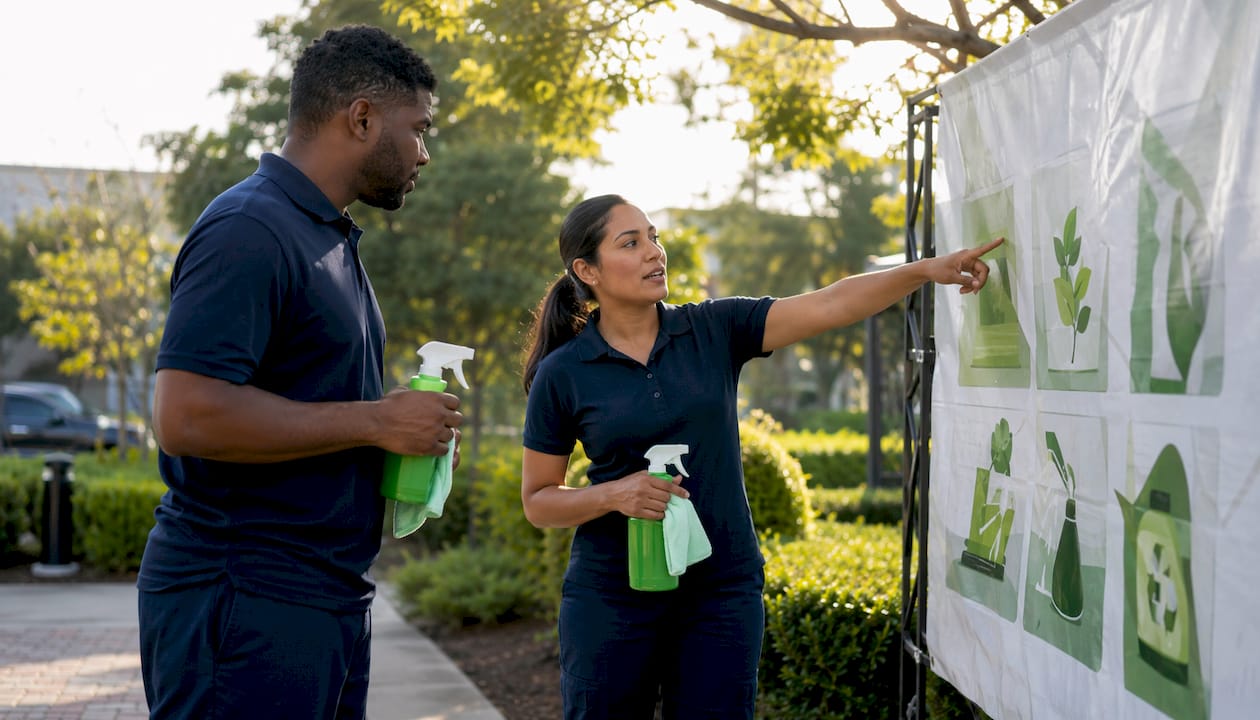
Staffing and training are where most programs fall short. Green-certified formulations can match or exceed conventional sanitizing performance, but only when staff apply them correctly. Role-based training tied to a CIMS framework, with documented SOPs and supervisor-led audits, is what separates a real program from a marketing claim.
Pro Tip: Ask for a sample QA checklist and one completed cleaning log before you sign. A provider who cannot produce these on request does not have a documented program.
What drives the price of eco-friendly cleaning services?
Green cleaning does not automatically cost more. Professional programs typically offset higher per-unit product costs with concentrated chemistries, reusable applicators, and reduced labor time, resulting in little to no net increase for comparable service levels.
- Square footage and layout complexity — open floor plans clean faster than dense office configurations with many private rooms and high-traffic corridors.
- Service frequency — daily high-touch disinfection costs more than a weekly deep clean. Both should appear as separate line items.
- Task depth — carpet extraction, window cleaning, and specialty services (post-construction, bio-cleaning) carry different rates than routine janitorial.
- Equipment requirements — electrostatic sprayers and HEPA vacuums add cost if the provider is sourcing them specifically for your site.
- Reporting and documentation — LEED O+M compliance reporting, IEQ worksheets, and monthly audit packets take staff time. Confirm whether this is included or billed separately.
- Concentrated vs. disposable systems — providers using concentrated dispensing and reusable microfiber typically offset product costs enough to keep total spend comparable to conventional programs.
A high-quality quote lists every task with a unit cost, names the specific certified products, states SLA metrics (response time, re-clean policy), and spells out pilot terms and termination clauses.
How to choose a green cleaning provider: a practical checklist
Start the evaluation before the first vendor call. Know what you need to see, and treat missing documents as disqualifying.
Vendor interview checklist:
- Request the full product certification list (Green Seal and/or EPA Safer Choice for every daily-use product).
- Ask for the CIMS certificate number and verify it independently.
- Review a sample IEQ/LEED O+M packet from a current or past client.
- Confirm the equipment list includes HEPA vacuums and microfiber systems.
- Ask for two client references from facilities of comparable size and use type.
- Confirm a 30-day pilot is available with defined KPIs and a written QA schedule.
Red flags to walk away from:
- Vague product claims ("all-natural," "eco-friendly") with no third-party certificate to back them
- No documented SOPs or staff training records
- No measurable QA program or audit support
- Green services listed as a separate fee with no explanation of what changes
- Inability to produce sample IEQ paperwork on request
Pro Tip: Weight certifications and documentation at least as heavily as price in your scoring rubric. A provider who cannot produce a CIMS certificate or sample LEED packet during procurement will not produce one during an audit either.
For multi-site portfolios, add multi-location coordination capability and centralized reporting to your scoring criteria. A provider managing property management accounts across multiple buildings should offer a single account manager and standardized documentation across all sites.
How Nationwidemaintenance delivers audit-ready green cleaning
Nationwidemaintenance operates a documented green and eco-friendly cleaning program covering the full scope: HEPA vacuums, microfiber systems, concentrated dispensing, green product purchasing logs, and IEQ/LEED O+M support documentation available upon request.
What that looks like operationally:
- Single account manager for multi-site clients across the Tri-State area (NY, NJ, CT)
- OSHA-compliant staff records and available Certificates of Insurance
- Sample QA checklist and pilot offer with defined KPIs
- Integrated facility services (cleaning, pest control, construction, landscaping) under one contract, which simplifies sustainability reporting across disciplines
To engage, request a site walkthrough, ask for a template IEQ packet, and confirm a 30-day pilot with written QA checkpoints. Nationwidemaintenance's 30-plus years serving Fortune 500 clients like Costco and CVS means the documentation infrastructure is already in place.
Pro Tip: Ask specifically for a sample IEQ credit worksheet from a comparable facility type. If the provider has done this before, they can produce one in minutes.
Key Takeaways
Verified certifications, documented SOPs, and a line-item quote are the three things that separate a genuine green cleaning program from a marketing claim.
| Point | Details |
|---|---|
| Require third-party certifications | Ask for Green Seal or EPA Safer Choice product lists before signing any contract. |
| Demand IEQ/LEED paperwork upfront | Request a sample credit worksheet during procurement, not after the contract starts. |
| Run a 30-day pilot with KPIs | Confirm QA checkpoints and re-clean policies in writing before the pilot begins. |
| Price is often cost-neutral | Concentrated systems and reusable applicators typically offset higher product unit costs. |
| Nationwidemaintenance | Offers integrated, documented green cleaning with HEPA, microfiber, and LEED O+M support across NY, NJ, and CT. |
Why integrated facility providers make sustainability reporting simpler
The conventional approach to sustainability in commercial facilities is to manage cleaning, pest control, grounds, and construction through separate vendors, then try to reconcile their documentation at audit time. That reconciliation is where sustainability programs quietly fail. Inconsistent product logs, mismatched SDS formats, and gaps in training records are almost always a vendor-coordination problem, not a policy problem.
An integrated provider changes that dynamic. When floor finishing, pest control, and janitorial services run under one contract with one account manager, the documentation stays consistent. Low-VOC floor finishes applied during a renovation, for example, can be logged alongside the cleaning program's product records rather than filed separately by a different contractor who may not know what the cleaning team is using. That kind of cross-discipline coordination is what actually protects IAQ during building work, and it is nearly impossible to achieve with fragmented vendors.
A site walkthrough with Nationwidemaintenance is a practical first step toward that kind of continuity.
Get a green cleaning pilot started with Nationwidemaintenance
Nationwidemaintenance gives property managers in NY, NJ, and CT a single contract covering cleaning, pest control, landscaping, and facility maintenance, with the green documentation infrastructure already built in. That means no chasing separate vendors for SDS sheets or IEQ worksheets at audit time.
To get started, request a line-item quote that includes your product certification list, a sample IEQ packet, COIs, and SDSs. Confirm a 30-day pilot with written KPIs and QA checkpoints. The team at Nationwidemaintenance will schedule a site walkthrough, deliver a written quote, and set a pilot start date.
Property managers and multi-site operators can reach Nationwidemaintenance directly through the commercial cleaning services page to request a quote or pilot.
Authoritative sources for verifying green cleaning standards
- Green Seal — Search the public database by certificate number to verify any provider's GS-42 claim.
- EPA Safer Choice — Search by product name or manufacturer to confirm ingredient-level certification.
- LEED O+M (USGBC) — The U.S. Green Building Council publishes LEED credit requirements for existing buildings; IEQ credits cover cleaning products and practices.
- ISSA/CIMS — The Cleaning Industry Management Standard registry allows you to verify a provider's certificate number independently.
- Nationwidemaintenance green cleaning page — Request sample IEQ documentation, SDSs, and COIs directly.
- Eco-label verification guide — A practical resource for procurement teams verifying what specific environmental seals actually cover on cleaning product labels.
When verifying any vendor claim, ask for the certificate number, pull two SDS sheets, and request one completed training record. Those three documents tell you more than any marketing deck.