
For commercial facility work, the rule is straightforward: hire a handyman for small repairs and routine maintenance that don't require permits, and bring in a licensed general contractor the moment a job touches structural systems, electrical panels, plumbing rerouting, or HVAC modifications. Getting this wrong isn't just a budget problem. It's a risk-management decision that can trigger code violations, void your property insurance, and expose your organization to liability.
Quick examples that illustrate the split:
- Emergency faucet replacement in the same location: handyman ticket, same-day dispatch.
- HVAC system upgrade requiring new ductwork or electrical circuits: licensed GC, permits required.
- Drywall patch after a minor leak: handyman. Structural wall removal to reconfigure a floor plan: GC with permits.
State contractor licensing boards and local building departments set the legal thresholds. For facilities that regularly need both maintenance and permitted construction, Nationwidemaintenance offers an integrated contract that covers both under one vendor.
Table of Contents
- What's the fastest way to decide who to call right now?
- What do "handyman" and "general contractor" actually mean in commercial settings?
- Licensing, permits, and code compliance you must verify before issuing work
- What insurance and bonding should you require, and why does it matter?
- What tasks fall to each provider in a commercial facility?
- What do handyman services and general contractor work actually cost?
- What should you verify before you sign anything?
- How Nationwidemaintenance solves the handyman vs. contractor problem
- How to move from ticket to final acceptance: a step-by-step flow
- Key Takeaways
- The real reason this decision is about risk, not cost
- One partner for maintenance and licensed construction
- Primary sources and verification resources
What's the fastest way to decide who to call right now?
Use this triage list before you open a work order:
- Does the job require a permit? Structural changes, electrical panel work, plumbing rerouting, or significant HVAC modifications typically require permits and a licensed GC.
- Does it involve multiple trades in sequence? Framing, then electrical, then plumbing, then drywall — that's a GC job.
- Is it a safety emergency? Gas leak, major water intrusion, or electrical fault: shut down the affected area, call emergency services if needed, then contact a 24/7 facility response provider.
- Is it a small, non-permit repair? Broken door hardware, patching drywall, replacing a light fixture, minor plumbing in the same location — handyman.
- Did a handyman ticket just grow? If scope expands mid-job (e.g., a fixture swap reveals corroded supply lines that need rerouting), stop the handyman work and escalate to a GC before proceeding.
Pro Tip: Build a one-page escalation matrix into your work-order system. When a ticket hits any permit trigger, it auto-routes to your GC vendor rather than sitting in a handyman queue.
What do "handyman" and "general contractor" actually mean in commercial settings?
A handyman in a commercial context is a skilled generalist who handles routine maintenance and small repairs — think quick fixes and non-permit tasks like patching walls, replacing hardware, painting, or swapping fixtures. No formal licensing is required in most states for this scope, though requirements vary.
A general contractor is a licensed professional who manages larger, permit-driven projects, coordinates subcontractors across trades, and bears legal responsibility for code compliance and permit acquisition. States typically require a contractor's license for jobs above certain dollar thresholds and for any work that needs a permit.
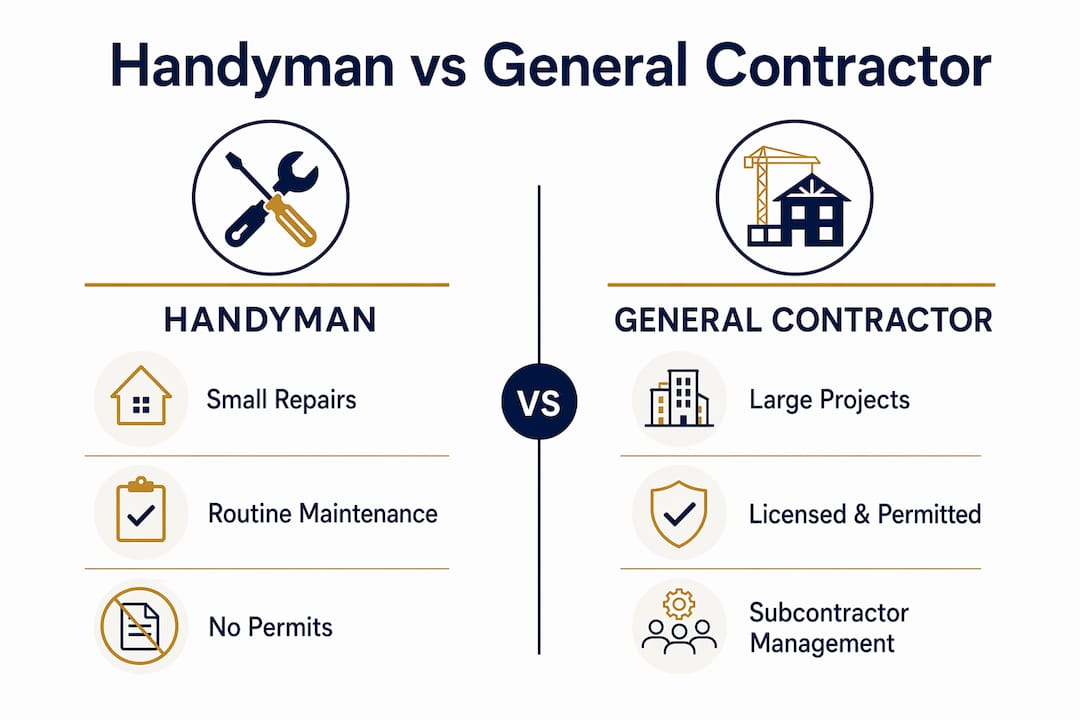
The critical nuance for facility managers: "handyman" is a loosely defined label in most U.S. jurisdictions, while "general contractor" carries regulated legal requirements. Using an unlicensed individual for work that exceeds local thresholds or requires permits can void your insurance and fail inspections. California, for instance, caps unlicensed contractor work at $500 in combined labor and materials. Verify the rules with your state licensing board before issuing any work order that might straddle the line.
Licensing, permits, and code compliance you must verify before issuing work
Permit triggers in commercial facilities include structural changes, electrical panel upgrades, plumbing rerouting, and significant HVAC modifications. These jobs require a licensed GC by law in most U.S. jurisdictions.
Before you issue work to any provider, run this verification sequence:
- Confirm the state license number. Look it up directly on your state contractor licensing board's public database — don't rely on a copy the vendor hands you.
- Check the local building department. Confirm whether a permit is required for the specific scope. When in doubt, call the department directly.
- Request proof of trade licenses for subcontractors. A GC's license doesn't automatically cover unlicensed subs doing electrical or plumbing work.
- Require a certificate of insurance (COI) before work starts. Verify it names your organization as an additional insured.
- Confirm permit issuance before work begins. A GC who pulls permits after starting work is a red flag.
What insurance and bonding should you require, and why does it matter?
Insurance requirements differ sharply between handymen and licensed contractors, and that gap is where facility managers get burned. Contractors must generally carry higher insurance levels and may require bonding, while handyman coverage is often optional in some states.
For any commercial engagement, require:
- General liability insurance (minimum $1 million per occurrence for most commercial work).
- Workers' compensation covering all workers on your property.
- Professional liability / errors and omissions when the scope involves design-build or systems engineering.
- Hired-and-non-owned auto if the vendor is hauling materials to your site.
For larger GC-managed projects, also require:
- Surety bond to protect against contractor default or non-performance.
- Lien waivers at each payment milestone to prevent subcontractors from filing liens against your property.
Pro Tip: When you receive a COI, don't just confirm it exists. Call the issuing insurance company directly to verify the policy is active and the limits match what's on the certificate. Expired or fraudulent COIs are more common than most facility managers expect.
What tasks fall to each provider in a commercial facility?
The practical split looks like this:
Handyman-appropriate tasks:
- Door hardware replacement, lock rekeying, and hinge adjustments
- Interior painting and minor drywall patching
- Light fixture swaps (same circuit, no panel work)
- Furniture assembly and minor carpentry
- Faucet or toilet replacement in the same location
- Parking lot signage and minor exterior repairs
GC-managed projects:
- Tenant improvement buildouts requiring permits
- Electrical panel upgrades or new circuit installation
- Plumbing rerouting or layout reconfiguration
- HVAC system replacement or ductwork modification
- Structural wall removal or addition
- Roof replacement or significant waterproofing work
The grey area is where scope creep creates real risk. A job can start as a handyman ticket but must convert to GC oversight if it expands — replacing a toilet is a handyman task, but relocating the drain line triggers licensed-trade involvement and permits. For multi-site facility operations, standardize your work-order descriptions to capture permit triggers and trade involvement at the ticket-creation stage, not after the work has started.
A hybrid approach also works well: use a GC for the permitted core work, then bring in a handyman for punch-list and finishing items. Coordinating this in contract terms up front reduces markup on small items and tightens schedule handoffs.
What do handyman services and general contractor work actually cost?
| Job Type | Typical Pricing Model | Cost Range | Typical Timeline |
|---|---|---|---|
| Handyman (routine repairs) | Hourly or flat fee | $50–$150/hour | Hours to 1 day |
| Small GC project (minor TI) | Fixed fee or T&M | Varies by scope + 10–20% GC markup | Days to 2 weeks |
| Mid-size GC project (remodel) | Fixed fee or T&M | Varies by scope + 10–20% GC markup | 2 weeks |
| Large GC project (full buildout) | Percentage of project cost | Varies by scope + 10–20% GC markup | 2–6 months |
General contractors typically charge 10–20% of total project costs as a markup or project-management fee, sometimes higher for complex projects. For procurement speed, request a fast verbal estimate from a handyman for jobs under $2,000. For GC work, require a formal written proposal with a defined scope, schedule, and payment milestones before issuing a purchase order. Tracking contractor hours against the proposal is one practical way to catch scope creep early; contractor hour tracking tools can automate this for larger projects.
What should you verify before you sign anything?
Selection checklist:
- Valid state contractor license (verified directly with the licensing board)
- Current COI with your organization named as additional insured
- References from commercial clients of similar size and scope
- Sample contract reviewed by your legal or risk team
- Dispute resolution clause (arbitration vs. litigation preference)
Contract clauses to require:
- Scope of work defined in writing with explicit exclusions.
- Change-order process requiring written approval before any out-of-scope work begins.
- Payment schedule tied to milestones, not calendar dates.
- Warranty terms covering both labor and materials.
- Lien waiver requirements at each payment.
- Indemnification clause protecting your organization from third-party claims.
- SLA for emergency response with defined response times and escalation contacts.
Red flags in vendor interviews:
- Reluctance to provide a license number or COI before starting.
- Verbal-only scope agreements with no written contract.
- Requests for large upfront payments (more than 30% is unusual for commercial work).
- No references from commercial clients.
- Inability to name which subcontractors will perform trade work.
How Nationwidemaintenance solves the handyman vs. contractor problem
For facility managers managing multiple sites or mixed-scope work orders, the handyman vs. contractor decision becomes a recurring procurement overhead. Nationwidemaintenance eliminates that overhead with a single integrated contract covering commercial handyman services, licensed construction, preventive maintenance, and 24/7 emergency response across commercial, retail, and industrial properties in the Tri-State area.
Key operational advantages for facility teams:
- Unified COI and bonding across all service lines, so you verify once rather than per vendor.
- Single point of contact for work orders spanning maintenance and permitted construction.
- 24/7 emergency response with defined SLAs, covering everything from water intrusion to structural damage.
- Multi-trade coordination for projects that start as maintenance tickets and escalate to GC-managed scope.
- Proven track record with major retail clients including Costco and CVS.
For property management firms managing multiple buildings, consolidating to one vendor also simplifies preventive maintenance contracts and post-completion warranty tracking.
How to move from ticket to final acceptance: a step-by-step flow
Step 1: Classify the job. Does it require a permit, involve multiple trades, or exceed your state's unlicensed-work dollar threshold? If yes, route to a licensed GC.
Step 2: Verify licensing and insurance. Run the verification checklist above before issuing any work authorization.
Step 3: Assign the provider and schedule. For handyman work, confirm availability and issue a work order with a defined scope. For GC work, require a written proposal before scheduling.
Step 4: Onboard the provider on-site. Confirm site access, active permits posted on-site, subcontractor vetting documentation, workspace protection measures, and a communication plan with defined check-in points.
Step 5: Inspect and accept. For permitted work, schedule a final building inspection before accepting the work. For handyman jobs, a walk-through with the site manager is sufficient.
Step 6: Document and hand off. Collect warranty documentation, as-built drawings for any structural or systems work, and a maintenance plan for post-completion upkeep. File these with the building's maintenance records.
Key Takeaways
The core rule for commercial facilities: permit-triggering or multi-trade work requires a licensed general contractor; routine repairs and non-permit maintenance belong on a handyman ticket.
| Point | Details |
|---|---|
| Permit triggers require a GC | Structural, electrical panel, plumbing rerouting, and HVAC modifications require a licensed contractor and permits by law in most U.S. states. |
| Always verify COIs directly | Call the issuing insurer to confirm the policy is active; don't accept a certificate at face value. |
| Handyman rates vs. GC markup | Handymen charge varying hourly rates; GCs typically add a percentage of total project cost as their fee. |
| Scope creep is a permit trigger | A job that starts as a handyman ticket must convert to GC oversight the moment it requires a permit or trade license. |
| Nationwidemaintenance integrates both | A single contract covers handyman services, licensed construction, and 24/7 emergency response across multi-site commercial portfolios in the Tri-State area. |
The real reason this decision is about risk, not cost
The conventional framing treats the contractor vs. handyman choice as a cost question. It isn't. The liability exposure from a single unpermitted job — a failed inspection, a voided insurance claim after a fire, a stop-work order mid-project — will cost far more than the premium you saved by skipping the licensed GC. Facility managers who treat this as a procurement shortcut eventually learn that lesson the hard way.
The smarter frame is compliance-first: classify the work correctly, verify the provider's credentials before the first nail goes in, and build escalation triggers into your work-order system so scope creep gets caught at the ticket stage rather than after the walls are closed. That discipline protects your budget, your building, and your organization's liability position over the full life of the asset.
One partner for maintenance and licensed construction
Nationwidemaintenance gives facility and property managers in the Tri-State area a single contract that covers the full spectrum: routine commercial handyman work, licensed construction and permitted buildouts, preventive maintenance programs, and 24/7 emergency response. No juggling separate vendors, separate COIs, or separate escalation chains when a maintenance ticket turns into a permitted project.

Every engagement comes with a unified certificate of insurance, bonding where required, and local permit management handled by Nationwidemaintenance's licensed team. Major retail and commercial clients including Costco and CVS rely on this model for consistent, compliant facility operations across multiple locations.
Ready to consolidate your vendor relationships and reduce procurement risk? Request a site assessment or review available maintenance contract options to see how a single integrated contract works for your portfolio.
Primary sources and verification resources
Use these authoritative sources when documenting procurement decisions or verifying provider credentials:
- Insureon: General Contractor vs. Handyman — Insurance and licensing requirements, COI guidance, and bonding standards for both provider types.
- Angi: Handyman vs. Contractor — Cost ranges, pricing models, and scope guidance for handyman and GC engagements.
- ProCraft Local: GC vs. Handyman — Risk-management framing and hybrid workflow guidance for facility procurement.
- Invoice Fly: Handyman vs. Contractor — Scope-change triggers and permit escalation examples.
- State contractor licensing boards — Search your state's licensing board database to verify any GC's license number before issuing work. Most states publish searchable public databases.
- Local building departments — Contact your local building department to confirm permit requirements for specific scopes before work begins.
- Property management trends — Industry context on vendor consolidation and multi-site procurement strategies for facility teams.