
Prevailing wage compliance means paying laborers and mechanics at least the federally determined minimum wage rates, including bona fide fringe benefits, on covered construction and maintenance projects. Under the Davis-Bacon Act and its Related Acts (DBRA), this requirement applies to federal and federally assisted contracts exceeding $2,000. The U.S. Department of Labor sets those rates by trade and geography, so an electrician in one county may carry a different floor than one two counties over.
For facility and property managers, the stakes are direct:
- Wage determinations cover both basic hourly pay and fringe benefits such as health insurance and pension contributions.
- The obligation flows down to every subcontractor on a covered project, not just the prime.
- Recent legislation, including the Infrastructure Investment and Jobs Act (IIJA), CHIPS and Science Act, and Inflation Reduction Act (IRA), has expanded the universe of covered projects significantly.
- Non-compliance exposes you to wage restitution orders, contract termination, withheld payments, and debarment from future federal work.
Prevailing wage compliance has shifted from a paperwork checkbox into a strategic mandate, driven by the scale of new federal infrastructure investment.
Table of Contents
- What are your legal obligations under prevailing wage laws?
- How do IIJA, CHIPS, and the IRA change your compliance picture?
- How consolidated contracts simplify prevailing wage compliance
- Best practices to keep your projects in compliance
- How to conduct wage surveys and determine the correct prevailing rates
- Procedures and documentation required for compliance monitoring
- State-specific variations you need to account for
- Nationwidemaintenance: your partner for compliant facility maintenance
- Key Takeaways
What are your legal obligations under prevailing wage laws?
The Davis-Bacon Act requires contractors to pay covered workers unconditionally, at least once a week, at no less than the applicable prevailing rate. That means the full wage plus fringe benefits, with no deductions or rebates.
One fact that trips up many managers: labor standards apply by operation of law even when an awarding agency forgets to include the wage clause in the contract. The omission does not create a loophole. Contractors are legally bound regardless of what the contract document says.
Common compliance failures include:
- Worker misclassification. Classification follows duties, not job titles. A worker operating a backhoe for part of a shift must be paid the equipment operator rate for those hours, even if their paperwork calls them a general laborer.
- Fringe benefit errors. Fringe benefits must be paid into qualified, irrevocable plans such as health insurance or pension funds. Cash-in-lieu payments require precise documentation and may not fully satisfy the requirement.
- Incomplete certified payrolls. Weekly submissions must include worker names, classifications, hours, wages, and fringe benefits, along with a signed Statement of Compliance.
- Inadequate posting. The applicable wage determination and the WH-1321 worker rights poster must be displayed visibly at the job site.
Penalty exposure is serious. Under the IRA, intentional wage violations can trigger penalties equal to three times the wage shortfall plus $10,000 per affected employee. Even standard DBRA violations can result in debarment for up to three years, which effectively bars a contractor from all federal work.
Prime contractors carry responsibility for their entire subcontractor chain. Reviewing initial certified payrolls for accuracy and requiring subcontractors to sign a compliance acknowledgment before work begins are baseline obligations, not optional best practices.
How do IIJA, CHIPS, and the IRA change your compliance picture?
The scale of new federal spending has made wage compliance standards a front-burner issue for commercial facility managers. The IIJA allocates $1.2 trillion toward infrastructure, with prevailing wage rules effective on covered projects since November 2021. The CHIPS and Science Act and the IRA add further layers.
Key compliance implications across these three acts:
- IRA tax incentives are conditional. Contractors and project owners seeking the IRA's enhanced clean energy tax credits must meet both prevailing wage and apprenticeship requirements. Meeting those conditions can multiply the base credit by a factor of five. Missing them forfeits most of the incentive.
- Apprenticeship mandates are new territory. The IRA requires that a defined percentage of labor hours on qualifying projects be performed by registered apprentices. Facility managers overseeing such projects need to verify apprenticeship program registration before work starts.
- IRS enforcement adds a second regulator. Unlike traditional DBRA projects where the Department of Labor leads enforcement, IRA-linked projects also fall under IRS scrutiny. That means two agencies can audit the same project.
- Record retention is non-negotiable. Across all three acts, maintain payroll and compliance records for a minimum of three years after project completion.
The practical takeaway: if your facility is receiving federal funding or claiming federal tax incentives for construction or renovation work, assume prevailing wage regulations apply and build compliance into the contract from day one.
How consolidated contracts simplify prevailing wage compliance
Managing compliance across a roster of separate vendors is where most facility managers lose control. Each subcontractor brings its own payroll system, classification practices, and documentation habits. When something goes wrong, tracing the failure takes time you rarely have.

A consolidated contract with a single provider changes that dynamic. Nationwidemaintenance bundles commercial construction services, cleaning, pest control, landscaping, and handyman work under one agreement, covering commercial, retail, healthcare, government, and industrial properties across New York, New Jersey, and Connecticut. With 30-plus years of experience and WBE certification, the company operates as the accountable prime on covered projects, managing labor classification oversight, certified payroll submissions, and subcontractor compliance flow-down from a single point of contact.
Pro Tip: Require any provider you consolidate under to produce a written prevailing wage compliance program before the contract is signed. Ask specifically how they handle worker reclassification mid-project and what their subcontractor vetting process looks like.
Centralized recordkeeping under one contract also means audit preparation is far less painful. Instead of chasing documentation from five vendors, everything lives in one compliance file.
Best practices to keep your projects in compliance
Getting wage compliance right starts before the first shovel hits the ground:
- Obtain the applicable Davis-Bacon wage determination from the Department of Labor's SAM.gov database before contract award, and confirm it covers every trade classification on the project.
- Post the wage determination and WH-1321 poster at the job site on day one.
- Require weekly certified payroll submissions from every contractor and subcontractor, due within seven days after each payroll period.
- Contractually obligate subcontractors to comply and provide proof of any required apprenticeship program registration before work begins.
- When a worker's duties don't fit an existing classification, submit a formal conformance request using SF-1444 rather than guessing at a rate.
- Conduct periodic on-site interviews with workers to cross-check payroll records. Discrepancies between what workers report and what payrolls show are a primary audit trigger.
- Retain all records for at least three years after project completion.
- Build compliance costs, including certified payroll administration and audit preparation, into your project budget from the start.
How to conduct wage surveys and determine the correct prevailing rates
The U.S. Department of Labor publishes prevailing wage determinations through its Wage and Hour Division. Here is how to use them correctly:
Step 1: Identify the project type and location. Wage rates vary by trade, project type (building, heavy, highway, or residential), and county. Pull the determination that matches all three.
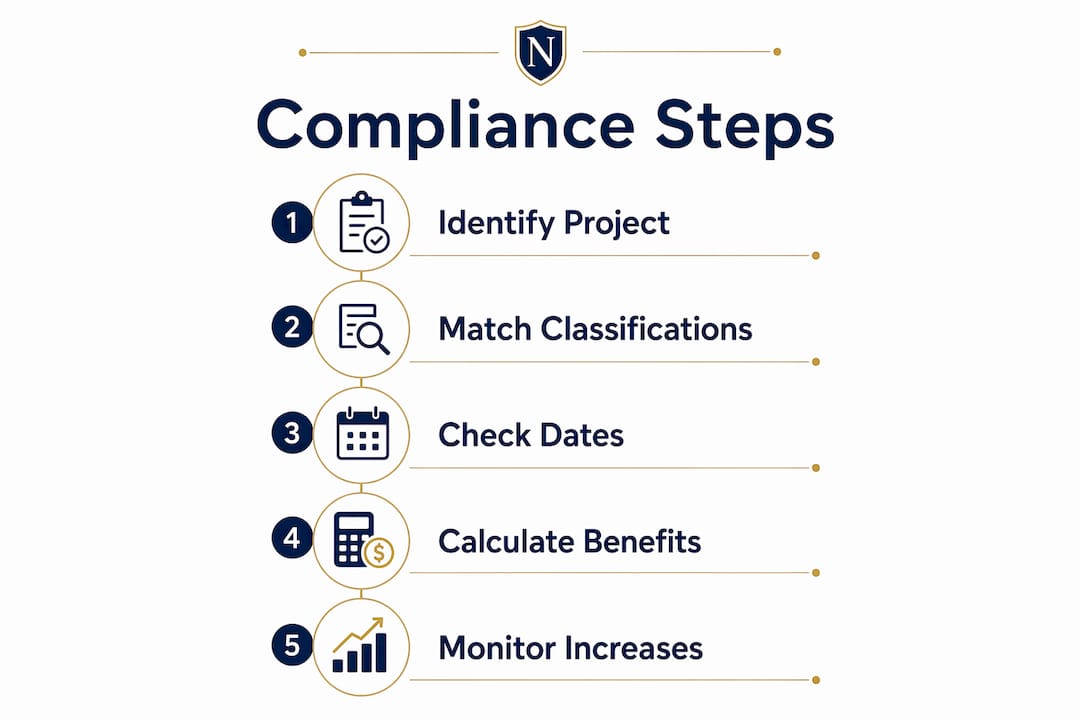
Step 2: Match every worker classification. List every trade that will perform work on the project. Cross-reference each against the applicable wage determination. If a classification does not appear, a conformance request to the contracting agency is required before work starts.
Step 3: Check the effective date. Wage determinations carry expiration dates. If your project spans a period when a new determination takes effect, the updated rate applies to work performed after that date.
Step 4: Account for fringe benefits. The total prevailing wage includes the basic hourly rate plus the fringe benefit amount. If you pay fringe benefits in cash rather than through a qualified plan, document the calculation carefully, as this is a frequent audit finding.
Step 5: Monitor for predetermined increases. Some determinations include scheduled rate increases. Build those into your labor cost projections so a mid-project rate bump does not catch you short.
Procedures and documentation required for compliance monitoring
Compliance monitoring is not a one-time event at contract award. It runs for the life of the project.
Weekly certified payrolls are the backbone. Each submission must include worker names, addresses, Social Security numbers, trade classifications, hours worked by day, straight-time and overtime rates, fringe benefit contributions, and a signed Statement of Compliance. Missing or unsigned statements require resubmission and can trigger a formal audit.
Beyond payrolls, maintain a project compliance file that includes the original wage determination, all posted notices, subcontractor compliance acknowledgments, apprenticeship registration documents, and records of any conformance requests. If the contracting agency or the Department of Labor requests records, you typically have ten days to produce them.
On-site worker interviews are an underused but highly effective monitoring tool. Spot-checking worker-reported hours and pay rates against certified payrolls catches classification errors before they become enforcement actions.
State-specific variations you need to account for
Federal Davis-Bacon rates set the floor, but many states layer their own prevailing wage requirements on top. In states with active "little Davis-Bacon" laws, state-funded projects carry separate wage determinations that may be higher than federal rates.
For facility managers working in New York, New Jersey, and Connecticut, state prevailing wage laws apply to a broader range of public works projects than federal law alone covers. New York's Labor Law Article 8, for example, extends prevailing wage obligations to projects funded by state or municipal agencies, with enforcement handled by the New York State Department of Labor. New Jersey's Prevailing Wage Act similarly covers public work contracts above a relatively low threshold.
When a project receives mixed federal and state funding, pay whichever rate is higher for each classification. Never assume the federal determination is sufficient without checking the applicable state schedule. State enforcement agencies conduct their own audits independently of federal oversight, so a project can be compliant under DBRA and still face a state violation.
Nationwidemaintenance: your partner for compliant facility maintenance
Prevailing wage compliance is demanding enough when you have one project. Managing it across multiple locations, trades, and subcontractors without a unified system is where exposure accumulates fast.

Nationwidemaintenance brings 30-plus years of commercial facility experience, WBE certification, and a single-contract model covering property management clients across NY, NJ, and CT. From commercial construction and carpentry to cleaning, pest control, and landscaping, every service runs under one agreement with one accountable team managing labor classification, certified payroll oversight, and subcontractor compliance. Government, healthcare, retail, and industrial clients rely on Nationwidemaintenance for 24/7 emergency response and eco-friendly service delivery that protects both their facilities and their compliance records. Contact Nationwidemaintenance to discuss a maintenance contract built around your compliance requirements.
Key Takeaways
Prevailing wage compliance requires accurate worker classification, weekly certified payrolls, and documented fringe benefits on every covered federal or federally assisted project.
| Point | Details |
|---|---|
| Compliance applies by operation of law | Missing wage clauses in contracts do not eliminate the obligation; contractors are legally bound regardless. |
| IRA penalties for intentional violations | Intentional failures under the IRA can trigger penalties equal to three times the wage shortfall plus $10,000 per affected employee. |
| IIJA funding scope | The IIJA provides $1.2 trillion to enhance nationwide infrastructure, expanding the pool of projects subject to prevailing wage rules. |
| State laws add requirements | NY, NJ, and CT each have state prevailing wage laws that may exceed federal Davis-Bacon rates on covered projects. |
| Nationwidemaintenance | A single consolidated contract covers construction, cleaning, and maintenance with built-in payroll and classification oversight across NY, NJ, and CT. |
Recommended
- Facility Maintenance for Government Buildings NY NJ CT | Nationwide Maintenance
- Facility Maintenance for Property Managers NY NJ CT | Nationwide Maintenance
- Facility Maintenance for Healthcare Facilities NY NJ CT | Nationwide Maintenance
- Commercial Facility Maintenance Service Areas. NY NJ CT | Nationwide Maintenance