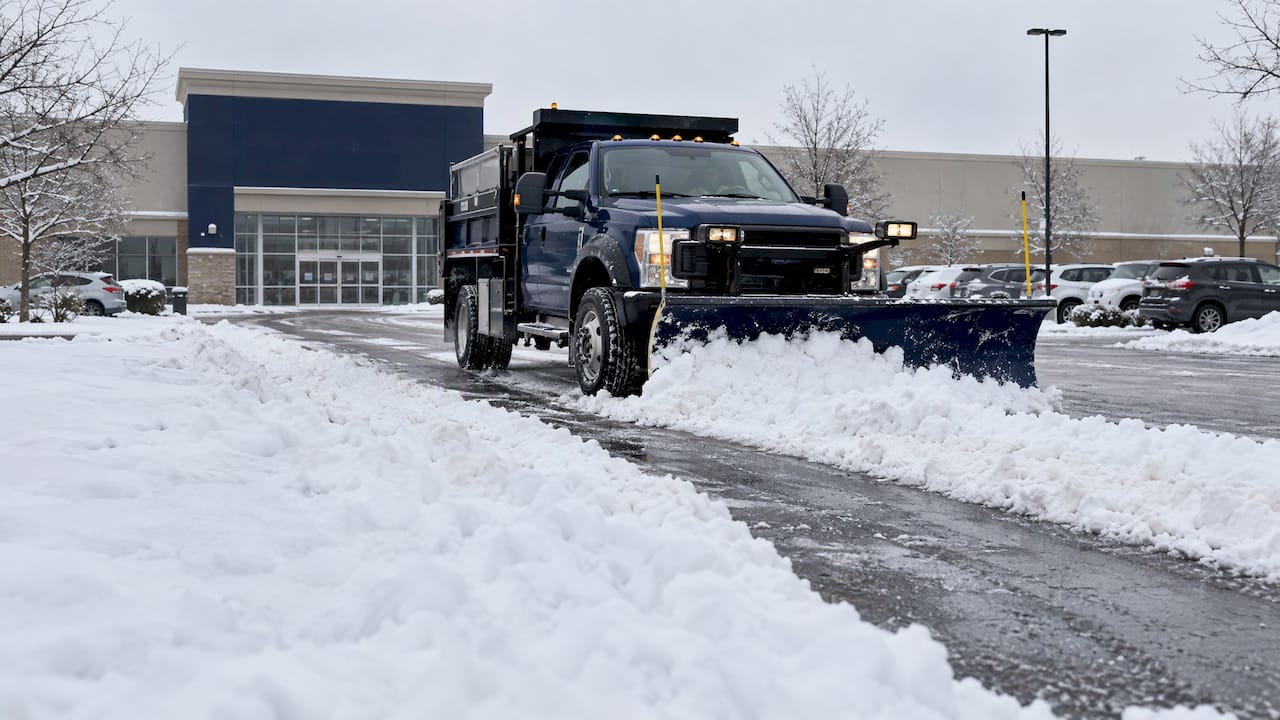
A commercial snow plan is a written agreement, made before the first storm, on what gets cleared, in what order, by when and who decides when crews roll. The properties that stay open and avoid slip-and-fall claims are the ones where those answers exist on paper in October, not the ones that call around at 4 a.m. during a storm. For multi-site managers, the simplest version is one contract, one site map per location and one emergency contact, which is how we run snow work alongside the rest of facility maintenance for our Tri-State clients.
TL;DR
- Start procurement early: the industry procurement standard puts the RFP no later than May and the award by September 1. If you are past that, sign before the first forecast storm, not after.
- Write a site assessment and site map first: entrances, emergency access, accessible parking, stacking zones and drains.
- Put the Level of Service in the contract in measurable terms: trigger depth, completion time, priority areas and post-storm checks.
- Require documentation of every deicing pass and know your municipality's sidewalk deadline, because the duty to clear usually stays with the owner or tenant.
- Consolidating snow with your other site services under one vendor means one set of contacts, one invoice and one chain of accountability.
Table of Contents
- What a snow response plan actually contains
- Step 1: Assess the property and map it
- Step 2: Set priorities and a measurable Level of Service
- Step 3: Define triggers and dispatch
- Step 4: Pick the right scope and contract terms
- Step 5: Build documentation and salt management into the plan
- Step 6: Know your local sidewalk and snow-storage rules
- Why one vendor for snow changes the plan
- A sample plan timeline
- How we approach it
- Put your plan in place
- FAQ
- Sources
What a snow response plan actually contains
A plan has five parts: a site assessment, a Level of Service (LOS), a trigger and dispatch method, a documentation routine and a communication plan. The LOS is the standard your property will be held to: how clear, how fast, in which areas. The rest of this guide builds those parts in the order you would do them.

Timing matters first. The Snow and Ice Management Association's ANSI-recognized procurement standard, published in June 2025, says the RFP process should begin no later than May, with contracts awarded no later than September 1, leaving time for site reviews, hazard mitigation, pricing negotiation and award. That pattern repeats every year. If you are reading this in late autumn with no contract, the work is the same, only compressed: assess, define the LOS, sign, then walk the site with the crew before the first accumulation.
Step 1: Assess the property and map it
A written assessment keeps a plan from being a guess. The same SIMA standard says the assessment should be created by an owner, agent, consultant or site manager with at least three winter seasons of experience. It should cover:
- Ingress and egress: every driveway, loading dock and fire lane.
- Access restrictions: gates, low clearances, tight turns that limit equipment size.
- Environmental proximity: streams, wells and other sensitive areas where salt runoff matters.
- Architectural hazards: roof drip lines, downspouts that discharge onto walkways, steps and ramps.
- Obstacles: islands, bollards, light poles, cart corrals, hydrants.
- Priority areas: the places that must be clear first.
Then draw the site map. It should show property boundaries, service areas, stacking zones and staging locations. Stacking is where plans fail most often. Piles placed upslope of a lot drain meltwater across the pavement and refreeze overnight, and piles at corners block drivers' sight lines. SIMA's best practices checklist specifically calls for placing snow so it avoids thaw-refreeze hazards and line-of-sight problems.
For a retail chain or a portfolio, build one template and customize it per site. Hospitals and clinics should rank ambulance bays and main entrances above everything else. Government buildings and schools should rank accessible routes and bus or pickup loops alongside them.
Step 2: Set priorities and a measurable Level of Service
The most common contract mistake is vague language: "keep lots clear." The SIMA standard asks signed contracts to define the Level of Service, scope of work and site plan, and to describe outcomes no more strongly than "substantially clear of hazards". No one can promise bare pavement during an active storm, and a promise like that invites disputes.
Name your priority areas explicitly. The standard lists ingress and egress for emergency responders, sidewalks, entrances, handicap stalls and delivery ramps. Rank them like this:
- Emergency vehicle access and fire lanes.
- Main entrances, sidewalks and accessible routes.
- Accessible parking stalls and their access aisles.
- Delivery ramps and docks.
- Customer and employee parking.
- Overflow and secondary lots.
SIMA's RFP guide gives examples of what a usable LOS looks like: passable walkways at an inch or less of accumulation, a stated accumulation trigger, completion times tied to patron hours and shift changes, and priorities such as sidewalks, handicap stalls and ramps clear by a set time, for example 7 a.m. Match the times to your operation. A pharmacy that opens at 8 needs a different clock than a warehouse with a 5 a.m. shift.
Accessible parking deserves its own line. Federal rules treat snow piled in an accessible space or blocking an accessible route as a failure to maintain accessible features, and SIMA's checklist references 28 CFR 36.211 on maintaining accessible features. Our guide to ADA parking compliance for property managers covers the year-round side of the same stalls.

Step 3: Define triggers and dispatch
A trigger tells the contractor when to start without a phone call. Choose one of two common models and write it down:
- Accumulation trigger: service begins at a set depth, such as one inch, and repeats at set intervals while snow continues.
- Forecast or event trigger: crews pre-treat or mobilize when a named forecast threshold is reached, with a scenario for severe weather.
Whoever holds service-control authority should also be in writing. Is it your site manager, the contractor, or both? The standard lists service-initiation triggers, critical timeframes and service-control authority among the contract items. Without that line, a crew may plow a lot that your tenants are still using, or wait for approval while ice forms.
Monitoring is the other half. Large public agencies show how seriously it can be taken. Toronto's 2024 major snow event plan describes forecast monitoring four times a day in winter and GPS on all winter maintenance equipment feeding a real-time dashboard to verify contractor performance. You do not need a city-scale system, but you do need a way to confirm that crews came, when they arrived and what they did. Ask for time-stamped service logs and, where possible, photos.
Step 4: Pick the right scope and contract terms
A complete scope covers more than plowing. Most commercial properties need some combination of lot plowing, sidewalk and entry clearing, deicing, monitoring, stacking or relocation and post-storm cleanup. List each one and say whether it is included in the seasonal price or billed per event.
On contract form, the SIMA standard says all snow and ice contracts and changes must be in writing and signed by both parties, with a minimum one-year term, multi-year or annually renewable where possible, cancellation clauses for both sides and service dates that cover the typical winter in your area. Check that yours includes:
| Contract item | What to write down |
|---|---|
| Scope of work and site map | Every area serviced, stacking zones, exclusions |
| Level of Service | Outcome wording, trigger depth, completion time |
| Priority areas | Ranked list with deadline for each |
| Service dates | Start and end of the season |
| Post-storm requirements | Cleanup, stacking, re-check for refreeze |
| Communication plan | Who calls whom, before and during events |
| Term and cancellation | Length, renewal, exit for both parties |
| Pricing structure | Per event, per push, seasonal, or hybrid |
Pricing varies by region, site size and storm frequency, so request written quotes for your own sites rather than relying on averages. Whichever pricing structure you choose, define what counts as an "event" so invoices are never a surprise. Our article on what belongs in a facility maintenance RFP lists the procurement items that carry over to snow.
On insurance, ask for current certificates and have your own broker confirm the coverage and additional-insured wording your lease or portfolio requires. That question belongs with your insurance adviser and counsel, not with a template.
Step 5: Build documentation and salt management into the plan
Documentation protects you if someone slips. Minnesota's pollution control agency publishes a model contract that asks for records of each deicing application: time, area, material, rate or quantity, pavement temperature and precipitation rate. It also calls for annual equipment calibration and review of deicing decisions by a contractor representative with current Smart Salting certification. Even if your state has no such program, the log format is worth copying.
The same model contract assigns the owner a few duties that are easy to forget:
- Provide a site map showing storm drains and water-collection points before November 1.
- Inspect lighting regularly from November 1 to April 30 and replace failed lights within a week.
- Post signage warning of localized slippery conditions.
- Notify the contractor in writing of any slip-and-fall or vehicle accident where slipperiness may have been a factor.
The agency also notes that chlorides from road salt can harm aquatic life, groundwater, drinking water and infrastructure, which is why application rates and the environmental part of your site assessment matter. Eco-friendly practice is part of how we work, and a plan that applies only what the pavement temperature calls for keeps both budget and runoff in check.
Add pre-event communication to your plan too. SIMA's checklist includes telling customers about the coming event and the planned response. A short template message to tenants or store managers (which lot is plowed first, where to park, when entrances will be clear) cuts calls during the storm.
Step 6: Know your local sidewalk and snow-storage rules
Cities set their own deadlines, and they differ a lot. Two examples show the range:
- Carbondale, Colorado requires owners, occupants or lessees to clear business-district sidewalks within four business hours after snowfall ends, or by the next business day's opening if that is sooner, and other sidewalks within 24 hours. It also bars pushing snow from private nonresidential property onto public streets, sidewalks or alleys.
- South Lake Tahoe's policy manual requires owners and tenants to clear walkways within 12 hours after a snow event ends, and within each 24-hour period during a longer event, when conditions are dangerous.
For properties in New York, New Jersey and Connecticut, check the municipal code for each town you operate in. The duty is typically on the owner or occupant, so your contract's completion times should be tighter than the local deadline, not equal to it. Never assume that hiring a contractor transfers the legal obligation to clear. Confirm liability allocation with your attorney.
For related surface issues once the snow melts, see our notes on commercial sidewalk maintenance.
Why one vendor for snow changes the plan
Snow plans for a single building are easy. Plans for a portfolio fail at the seams: one company plows, another cleans entrances, a third fixes the broken drain, and nobody owns the wet floor inside the door. When a contractor handles snow and the other site services under one agreement, you write one escalation path and review one set of records.
This is the problem Nationwide Maintenance was built around: cleaning, pest control, construction and landscaping under a single contract, for commercial, retail, industrial, healthcare and government properties in the Tri-State area. Our commercial snow removal services for NY, NJ and CT sit alongside that, with 24/7 emergency support. For property managers with many addresses, our facility maintenance for property managers page explains how multi-location contracts work.
We are also a WBE-certified vendor, which matters to organizations that must meet supplier diversity requirements. Folding snow into an existing contract keeps that spend with one qualified supplier rather than adding another vendor to onboard.
A sample plan timeline
Use this calendar as a starting pattern and adjust it to your market's winter:
- Spring (by May): issue the RFP with site maps and LOS language.
- Summer: review bids, negotiate, and settle terms. Award by September 1.
- Early fall: joint walk-through, update the site map, confirm stacking zones and drains, test lighting.
- Before the first storm: send the communication template, confirm contacts and triggers.
- During the season: review service logs after each event, record incidents in writing.
- After the season: the SIMA standard calls for a joint inspection within 30 days of the season's end to catalog damage to pavement, landscaping and fixtures.
How we approach it
Snow is a facility problem, not only a plowing problem. The lot, the sidewalk, the entrance mat, the loading dock and the emergency contact all fail together when they sit with different vendors.
Our view is that the best snow plan is the one written into the same contract as the rest of the site's care. We have more than 30 years of experience maintaining commercial, retail and industrial properties across the Tri-State area, and the pattern we plan around is simple: define the priorities first, put the response clock in writing, and keep one accountable partner and one 24/7 line for everything that goes wrong.
For clients with several locations, a single agreement means the same standard at every address, which is what protects both safety and brand presentation.
Nationwide Maintenance.
Put your plan in place
If you manage commercial, retail, healthcare, school or government properties in New York, New Jersey or Connecticut, we can fold snow removal into the same contract that covers your cleaning, pest control, landscaping and repairs. Tell us your sites and your priority areas, and we will build the plan around them.

Start with our commercial snow removal page, or see everything we handle for one contract at nationwidemaintenance.com.
FAQ
When should a business plan for commercial snow removal?
The industry procurement standard places the start of the RFP no later than May and contract award by September 1. That gives time for site reviews and negotiation. If the season is already close, assess your site and sign a written agreement before the first forecast storm.
What should a snow removal contract include?
At minimum: a signed written agreement, scope of work, site map, Level of Service, trigger depths, priority areas, post-storm requirements, a communication plan, season dates and cancellation terms for both parties. Use outcome wording such as substantially clear of hazards rather than a promise of bare pavement.
Who is responsible for clearing sidewalks at a commercial property?
In most municipalities the owner, occupant or lessee is responsible, and deadlines vary by city. Carbondale, Colorado, for example, sets four business hours for business-district sidewalks, while South Lake Tahoe sets 12 hours. Check your local code and ask your attorney how your lease and contract allocate liability.
What should a snow response plan do with the snow itself?
It should name stacking zones on the site map, away from entrances, accessible stalls, drains and sight lines. Piles placed where meltwater crosses walkways can refreeze, so the plan should also schedule a post-storm check.
Sources
- Procuring and Planning Snow and Ice Management Services (SIMA/ANSI, 2025)
- Purchasing Snow & Ice Management: Quality RFP Creation and Best Practices (SIMA)
- Best Practices Checklist (SIMA)
- Model Contract for Snow and Ice Management (MPCA)
- Major Snow Event Response Plan Update (City of Toronto, 2024)
- Carbondale Municipal Code, Chapter 11
- Snow Removal Policy and Procedures Manual (City of South Lake Tahoe)