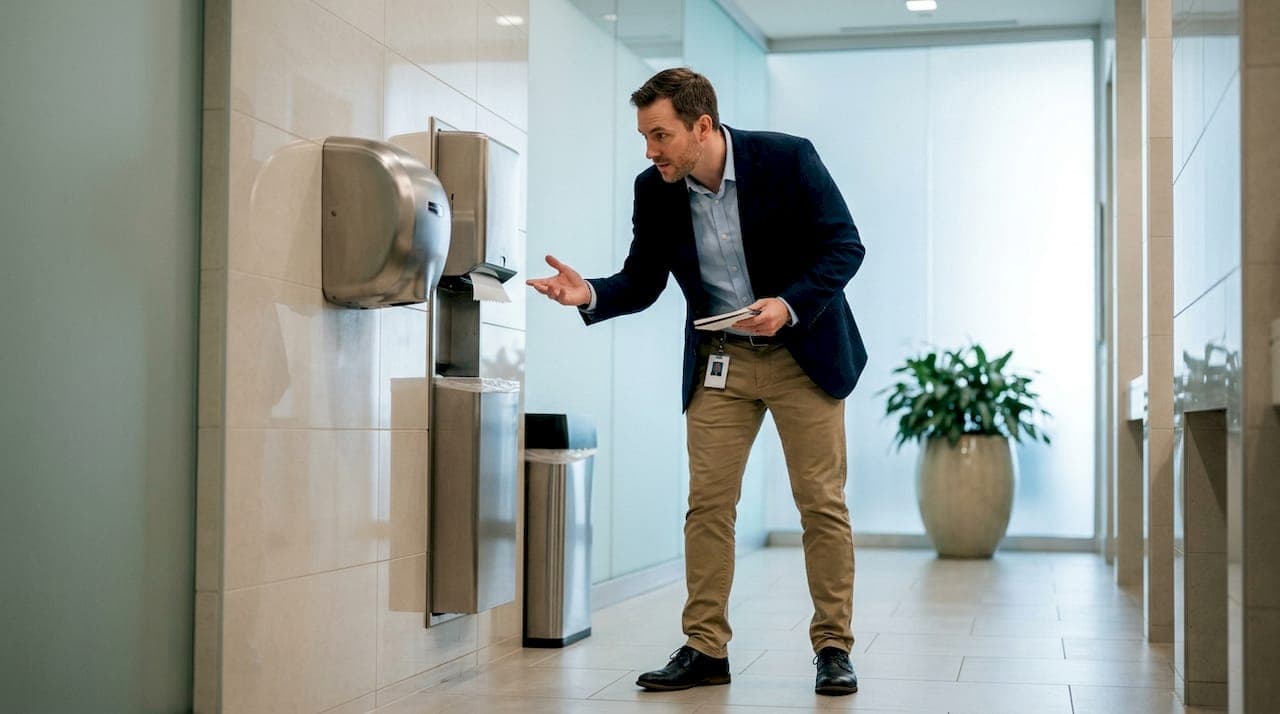
For most commercial properties, the right answer is a mixed approach: touchless paper towel systems in clinical, food-prep, and high-infection-risk zones, and high-speed jet dryers in high-traffic public restrooms. A 2019 controlled study found jet air dryers achieved a high removal rate of S. marcescens under controlled conditions. A 2024 aerosolization study found no significant difference between jet dryers and paper towels in surface transfer or airborne counts under realistic conditions. Meanwhile, the Mayo Clinic Proceedings review recommends paper towels where infection risk is highest, such as hospitals and clinics.
a high bacterial removal rate achieved by jet air dryers under controlled lab conditions in a 2019 Scientific Reports study, the highest of any method tested.
Hygiene trade-offs at a glance:
- Jet dryers (Dyson Airblade, XLERATOR, Mitsubishi Jet Towel) perform well in public zones when users hold hands stationary and drying time is adequate.
- Paper towel systems remain the conservative choice for healthcare and food service; some studies have cultured bacteria from unused recycled towels, so supply-chain quality matters.
- The 2024 chamber study found airborne counts were more often driven by room movement than by the drying method itself, which counters the blanket claim that dryers aerosolize pathogens.
- Professor Mark Wilcox and other infection-control experts advise paper towels for clinical settings; the broader literature remains mixed.
- Warm-air dryers require 40–45 seconds00393-X/abstract) to reach comparable dryness; paper towels and jet dryers reach high dryness in roughly 10 seconds.
Comparison table — hand-drying options for commercial facilities:
| Dimension | High-Speed Jet Dryers (Dyson Airblade, XLERATOR, Mitsubishi Jet Towel) | Warm-Air Dryers (World Dryer economy line) | Touchless Paper Towel Systems | Roll / C-Fold / Multifold Dispensers |
|---|---|---|---|---|
| Hygiene / microbial removal | High under controlled use; no significant aerosolization vs. towels in realistic tests | Moderate; wet hands increase transfer risk | High; physical removal preferred in clinical zones | Moderate; quality and storage conditions affect microbial load |
| Dry time | ~10–15 seconds (lab) | 40–45 seconds | ~10 seconds | ~10 seconds |
| Initial cost (equipment + install) | High ($500–$1,500+ per unit + electrical) | Moderate | Low–moderate (dispenser + mounting) | Low |
| Ongoing cost | Low (energy only) | Low–moderate | High (consumables + waste removal) | High (consumables + waste removal) |
| Environmental impact | Lower GHG on low-carbon grids; LCA outcomes depend on regional energy mix | Worse than jet dryers; longer run time | Depends on recycled content and disposal | Depends on paper sourcing |
| Maintenance & logistics | Filter checks, motor service; no stocking | Minimal | Frequent restocking; waste bin management | Frequent restocking; overflow risk |
| Noise level | High (70–90 dB) | Low–moderate | None | None |
| ADA compliance | Requires correct mounting height and clearance | Requires correct mounting | Touchless models support ADA | Manual models may not |
| Durability / vandal-resistance | High (metal housing options) | Moderate | Moderate (lockable dispensers available) | Low–moderate |
| Best fit by facility type | Airports, offices, retail, transit hubs | Low-budget or low-traffic facilities | Hospitals, clinics, food prep, schools | Low-traffic or supplemental zones |
Procurement checklist before you specify:
- Confirm 20-amp dedicated circuit availability (jet dryers typically draw 1.5 kW; some models require hardwired installation).
- Verify ADA clearance: mounting height 15–48 inches from floor, knee clearance for forward-reach users.
- Request decibel ratings from vendors; units above 85 dB may conflict with noise ordinances in some jurisdictions.
- For jet dryers, ask for HEPA or equivalent filter specs and replacement intervals.
- For paper towel systems, budget waste removal frequency and bin capacity to prevent overflow, a common hygiene failure point.
- Run a simple local lifecycle assessment or supplier questionnaire before assuming one method is greener — grid carbon intensity varies significantly across U.S. regions.
- Pair any method with a complete hand-hygiene program; systematic reviews consistently show that washing technique and thorough drying together drive infection-control outcomes, not the drying method alone.
Pro Tip: For jet dryers, instruct users to hold hands stationary inside the air column rather than moving them in and out. User behavior materially changes real-world bacterial removal performance.
Table of Contents
Nationwidemaintenance handles specification, installation, and ongoing service
Choosing the right system is only half the decision. Getting it installed correctly, kept compliant, and restocked reliably is where most facility managers lose time. Nationwidemaintenance brings 30+ years of full-service facility maintenance across NY, NJ, and CT, handling the entire hand-drying project under one contract.
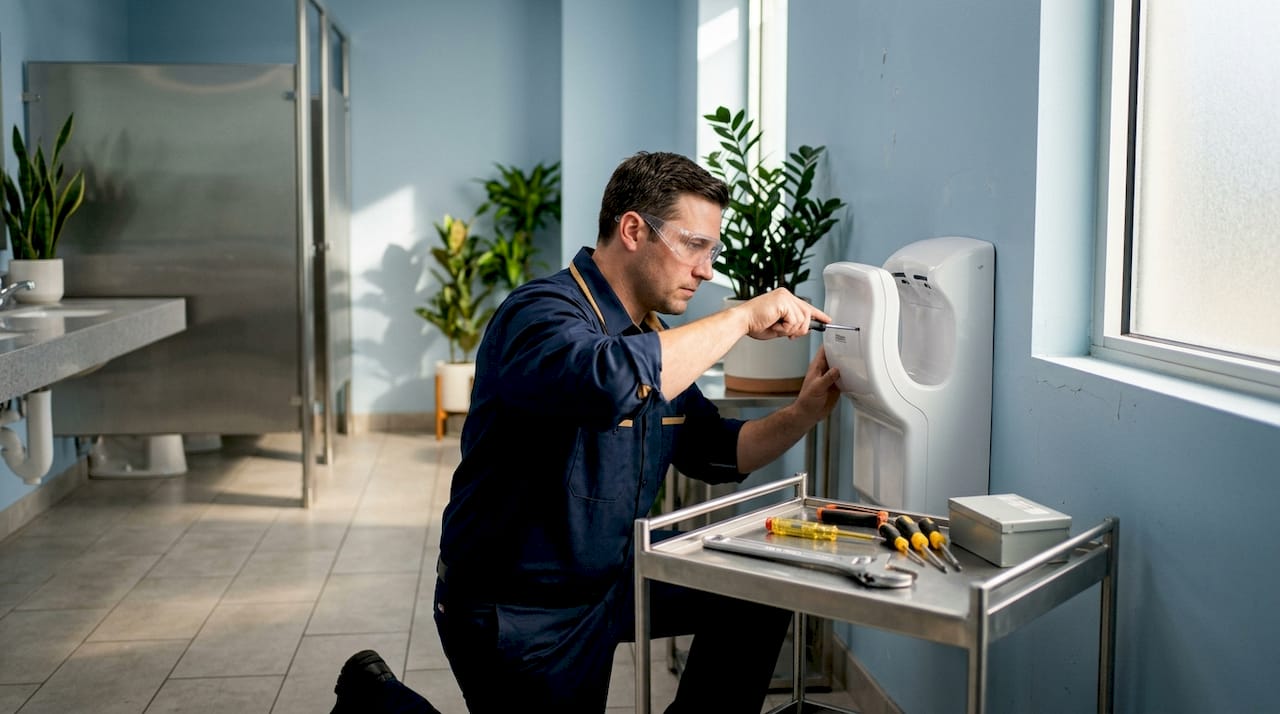
What that looks like in practice:
- Site survey and specification: Nationwidemaintenance assesses electrical capacity, ADA clearance, traffic volume, and facility type before recommending a system, so you are not retrofitting a dryer into a circuit that cannot support it.
- Turnkey installation: From plumbing fixture installation and electrical rough-in to bathroom renovation work and ADA adjustments, the crew handles the full scope.
- Scheduled maintenance and consumables management: Filter replacements, motor checks, paper towel restocking, and waste removal are bundled into maintenance contracts so nothing falls through the cracks between vendors.
Questions to bring to your vendor or RFP meeting:
- What is the unit's power draw, and does our existing panel support it without a dedicated circuit upgrade?
- What is the warranty term, and does it cover parts and labor on-site?
- What is the HEPA filter replacement interval and cost?
- What decibel rating does the unit produce at 3 feet?
- For paper towel systems: what is the recommended restocking cadence for our projected daily traffic volume?
Property managers across the Tri-State area can request a site audit, written specification, and quote. Contact Nationwidemaintenance to get started.
How the main hand-drying products compare
| Product / Category | Google Reviews | Hygiene fit | Dry time | Best for |
|---|---|---|---|---|
| Nationwide Maintenance | — | Full-service: installs and maintains any system | Depends on specified product | Facility managers wanting turnkey procurement + service in NY/NJ/CT |
| Dyson Airblade | — | High under controlled use; fast air-sweep design | ~10–15 s (lab) | High-traffic public restrooms |
| XLERATOR (Excel Dryer) | — | Market-proven; broad commercial install base | ~10–15 s | Institutional and commercial buildings |
| Mitsubishi Jet Towel | — | Fast drying; compact footprint | ~10–15 s | Sites needing compact hardware with jet performance |
| World Dryer | — | Moderate; economy and high-speed lines available | 20–45 s (model-dependent) | Facilities needing multiple price-point options |
| Commercial paper towel systems | — | Preferred in healthcare and food prep; physical removal of moisture | ~10 s | Clinical, food-service, and high-infection-risk zones |
Key Takeaways
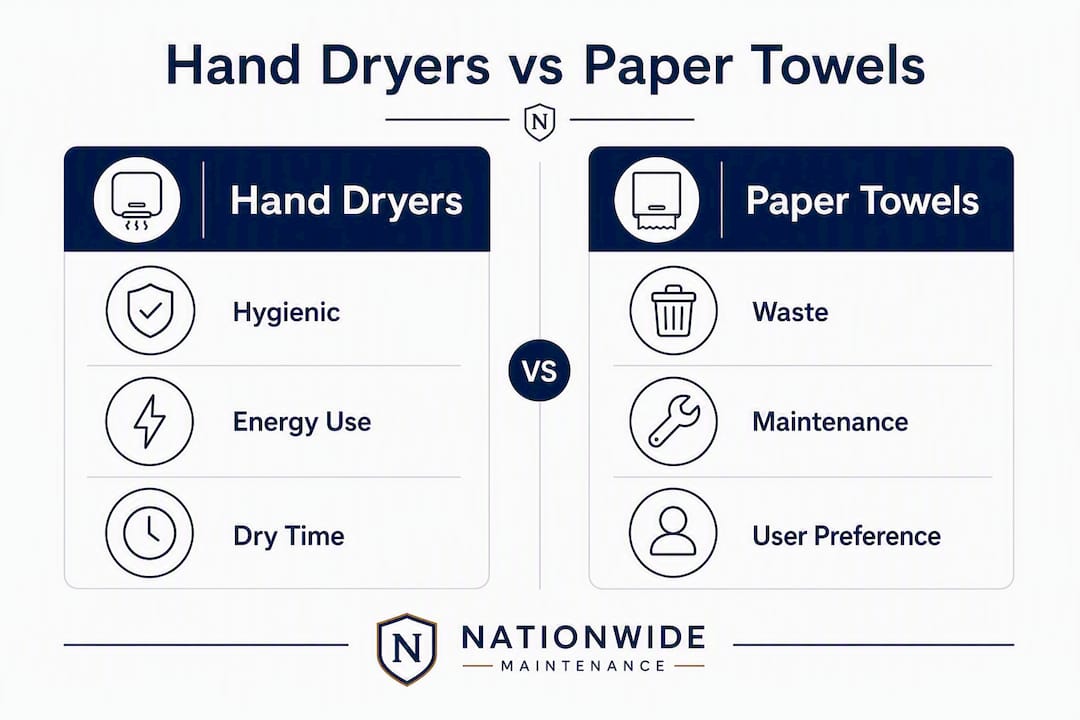
For most commercial facilities, a mixed approach combining high-speed jet dryers in public zones and touchless paper towel systems in clinical or food-prep areas delivers the best balance of hygiene, cost, and compliance.
| Point | Details |
|---|---|
| Mixed approach wins | Jet dryers suit high-traffic public areas; paper towels remain the standard for clinical and food-prep zones. |
| Hygiene evidence is nuanced | A 2019 study recorded 94.9% bacterial removal with jet dryers; a 2024 study found no significant aerosolization difference vs. paper towels. |
| Warm-air dryers lag behind | Warm-air units need 40–45 seconds to reach comparable dryness, making them the weakest option for busy facilities. |
| Environmental impact is grid-dependent | High-speed jet dryers typically outperform paper towels on lifecycle GHG when powered by low-carbon electricity; run a local assessment before deciding. |
| Nationwidemaintenance | Provides site surveys, turnkey installation, ADA adjustments, and ongoing maintenance contracts across NY, NJ, and CT. |